LehrePlus!-Preis in der Kategorie e-Learning für Kurs “Open Organizations and Organizing Openness”

lehre-plus-cutAlle zwei Jahre werden an der Universität Innsbruck unter dem Titel “LehrePlus!” Preise für exzellente Lehre vergeben. In der Kategorie e-Learning wurde 2016 Leonhard Dobusch für seine wiki-basierte Lehrveranstaltung mit dem Titel “Open Organizations and Organizing Openness” ausgezeichnet (vgl. zu den Hintergründen des Kurses einen englischen Beitrag bei governance across borders). Die Preisverleihung in der Aula der Universität Innsbruck findet am 10. November 2016 um 17 Uhr statt (Einladungsflyer).
Continue reading “LehrePlus!-Preis in der Kategorie e-Learning für Kurs “Open Organizations and Organizing Openness””

New Publication: »Making an Impression with Openness: How Open Strategy-Making Practices Change in the Evolution of New Ventures«

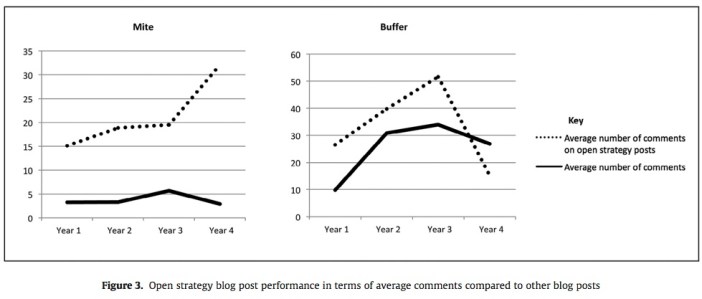
gegenhuber-dobusch2016figure3

Thomas Gegenhuber and I have tracked open strategy-making practices on blogs of two ventures (Berlin-based mite and buffer in San Francisco) over the period of four years to answer the research question “how new ventures use open strategy-making as impression management over time?”. The article entitled “Making an Impression Through Openness: How Open Strategy-Making Practices Change in the Evolution of New Ventures” has now been accepted for publication in Long Range Planning as part of a special issue on Open Strategy (edited by Julia Hautz, David Seidl and Richard Whittington). The abstract reads as follows:

While previous open strategy studies have acknowledged open strategy’s function as an impression management instrument, their focus has mostly been on short episodes. The impression management literature, meanwhile, pays openness scant attention. By studying how new ventures engage in open strategy-making, we track how open strategy-making and respective impression management benefits evolve over time. Specifically, we draw on a comparative case study of two firms’ blog communication on strategy-related issues and corresponding audience responses over a four-year period. We identify three distinct modes of how organizations engage in open strategy-making with external audiences and show how each mode is related to a specific set of impression management effects. Having established the impression management functions of these modes, we then demonstrate how open strategy-making contributes to new ventures’ quests for legitimacy as they evolve. In the launch phase, dialoguing with blog audiences helps a venture attract endorsements for its organization and products. As the venture grows, concentrating on broadcasting relevant strategic information may attract media audiences’ additional support for pursuing openness as a desirable organizational practice.

Thomas has also blogged about our study. If your institution does not provide access to the article just e-mail me and I would be happy to share it with you. For more on open strategy-making in general and other contributions to the special issue in Long Range Planning, join the recently launched Open Strategy Network.

New Online Portal for Alumni of the Organization Studies Master Program at University of Innsbruck

Screenshot of the new Alumni landing page

In addition to the OS ConJunction Community blog, we are happy to present a new Alumni portal on the official website of the unit of organization studies at University of Innsbruck. Continue reading “New Online Portal for Alumni of the Organization Studies Master Program at University of Innsbruck”

EGOS Sub-theme Call for Papers: »Open Strategy: Practices, Perspectives and Problems«

screenshot-egos-copenhagen

The 33rd EGOS Colloquium will take place from July 6–8, 2017 in Copenhagen, Denmark, and together with Georg von Krogh (ETH Zürich) and Richard Whittington (Oxford University) I will be convenor of sub-theme 50 on “Open Strategy: Practices, Perspectives and Problems“. Please find the Call for Short Papers below, submission deadline is January 9, 2017:

Many organizations in public, private and non-for-profit sectors are becoming more transparent about their strategies, while also including a wider range of actors in strategy development. These moves involve a variety of strategy practices, for example strategy jamming (Bjelland & Wood, 2008), strategy crowdsourcing (Stieger et al., 2012), strategy blogs and wikis (Dobusch & Kapeller, 2013) or strategy simulations in online games (Aten & Thomas, 2016). Although involving many different practices, this phenomenon has been described most comprehensively as ‘open strategy’ (Chesbrough & Appleyard, 2007; Whittington et al., 2011).

Building upon these studies, recent works on open strategy have begun to look at open strategy from an increasing variety of perspectives such as impression management (Whittington et al., 2016), middle-management inclusion in strategy-making (Wolf et al., 2014) or the inter-organizational explorations of strategic issues (Werle & Seidl, 2015). However, systematic cross-fertilization between the emerging open strategy literature and other areas and concepts of organizational openness are still rare. Continue reading “EGOS Sub-theme Call for Papers: »Open Strategy: Practices, Perspectives and Problems«”

Looking back on the Academy of Management Annual Meeting 2016 in Anaheim, California

IMG-20160805-WA0013
Enjoying California’s most healthy food together with Max Heimstädt (FU Berlin) and Katharina Kreissl (University of Vienna)

After Disneyworld Orlando in 2013, this year’s Academy of Management Annual meeting was again in a Disney resort, only this time in Anaheim, California. A lot happened during five days packed with workshops, meetings, presentations and, of course, receptions at the world’s largest gathering of management and organization scholars. What follows is a short list of my personal highlights at this year’s meeting:

  • I presented the paper on “Communicating Corporate Afterlife: Post-mortem Statements of Failed Startups”, co-authored with my former FU-Berlin-colleagues Nils Köster and Erik Schäfer. (see Pecha-Kucha-style slides below; in case you’re interested in the draft paper, just send me an email)
  • AOM2016-0I was honored to contribute to the first edition of the Strategizing Activities and Practices (SAP) Interest Group’s “Doctoral & Early Career Program” in a Professional Development Workshop on post-PhD career strategies.
  • I was honored to receive one of several “Outstanding Reviewer” Awards of the SAP Interest Group.
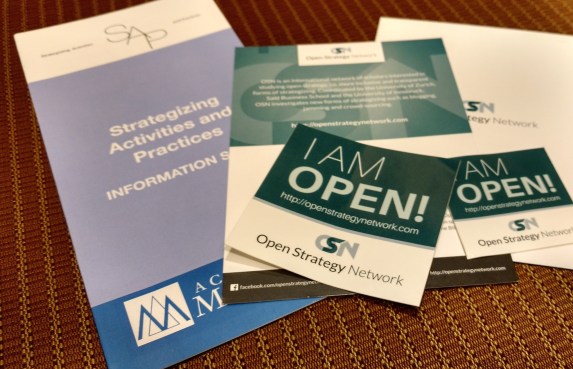
  • As one of the co-founders of the recently launched “Open Strategy Network“, I made sure some merchandise was made available to fellow strategy researchers.

SAP-meets-OSN-kl


»Zeit für Wissenschaft«: Leonhard Dobusch im Podcast der Universität Innsbruck

bild-zfw032
Zeit für Wissenschaft” ist der Titel der offiziellen Podcast-Reihe der Universität Innsbruck, in denen sich Melanie Bartos mit WissenschaftlerInnen ausführlich über ihre jeweilige Forschung unterhält. In der Ausgabe 32 der Podcast-Reihe war Leonhard Dobusch vom Institut für Organisation und Lernen das Gegenüber und sprach mit Melanie Bartos über Open Source, Creative Commons, Wikipedia und das Thema organisationale „Offenheit“ ganz allgemein.

Download des Podcasts als MP3

Erfreulicherweise – und passend zum Thema dieser Ausgabe – steht der Podcast unter einer Creative Commons Lizenz.

Open Strategy Network: New Platform for Research on Open Strategy-making

Foto: Leonhard Dobusch, CC-BY 4.0

Fueled by new digital technologies and by the perceived success of concepts such as ‘open innovation’, we can observe a growing interest in open forms of organizing more generally both among practitioners as well as among organization scholars (see also the wiki-based course on the matter). One such new field representing the interest in organizational openness is the realm of strategy research under the label of ‘Open Strategy’. The recently launched online community platform ‘Open Strategy Network‘ tries to connect and foster exchange among scholars interested in this emerging phenomenon.

The platform has been initiated by David Seidl and Violetta Splitter (University of Zurich) together with Richard Whittington (Oxford University) and myself. Registered users will be able to contact each other and browse through open strategy articles listed in the bibliography. Currently, the number of entries in the bibliography is limited but several articles on different facets of open strategy are already in the pipeline – for instance, Long Range Planning will soon feature a special issue on ‘Open Strategy – Transparency and Inclusion in Strategy Processes‘.

To receive updates from the Open Strategy Network on new publications and other news related to open strategy research please follow @OpenStrategyNet on Twittter and Facebook or subscribe to the newsfeed of openstrategynetwork.com.

Organizational Improvization beyond the Jazz Metaphor: Indian Music and Music Therapy

This research essay is authored by Cäcilia Bart, student in the master program Organization Studies at Universität Innsbruck.

Foto: Jason Baker, CC-BY 2.0

Metaphors help t o understand organizations from different perspectives. Over the past 20 years the dominant metaphor for understanding organizational improvisation has been that of the Jazz band (Kamoche et al., 2003). However, this focus on one metaphor implies that we have forgotten an important lesson that Morgan (1997) taught us about metaphors: “a way of seeing is also a way of not seeing”. Continue reading “Organizational Improvization beyond the Jazz Metaphor: Indian Music and Music Therapy”

Organizing Intuition and Playful Practice: The Jazz Band Metaphor Revisited

This research essay is authored by Hannes Henzinger, student in the master program Organization Studies at Universität Innsbruck.

“The intuitive mind is a sacred gift
and the rational mind is a faithful servant.
We have created a society that honors the servant
and has forgotten the gift.” (Albert Einstein)

Preservation Hall Jazz band (Foto:  Infrogmation, CC-BY-SA 3.0)
Preservation Hall Jazz band (Foto: Infrogmation, CC-BY-SA 3.0)

A common narrative in today’s organization and management literature is that this world, especially the world of business, has become increasingly complex and unpredictable. Not just the scope, also the velocity of change has increased. Such a dramatic shift in the image of the environment seems to ask for an abandonment of old organizational practices. Not just bureaucracy seems outdated. Even stable strategies, routines, and planning are running the risk of falling short of what is needed to react timely and adaptively in this new environment. This narrative calls for a reconstruction of the practice of organizing, “new models and metaphors are needed for organizing” (Barrett, 1998, p. 605). The metaphor of a jazz band, introduced by Karl Weick, is a particularly catchy one. With an allusion to peak performance, like a “flow” experience (Csikszentmihalyi, 1990), it elegantly charms the reader into seeing jazz aspects in organizing and decision making. Beyond the lessons that are elaborated on in the article by Barrett (1998) the metaphor offers two further potentially valuable aspects, that, although foundational to the metaphor, often go unnoticed: the role of intuition in organizing and decision making and playful practice. Continue reading “Organizing Intuition and Playful Practice: The Jazz Band Metaphor Revisited”

New Category at the ConJunction Blog: Student Research Essays

In some Organization Studies courses, students are required to write a short research essay, addressing one focused question or thesis related to the course topic. These essays are distinct from ‘ordinary’ seminar or term papers not only due to their short length but also because the students are encouraged to take a clear, maybe even provocative stance.

Foto: Bernhard Ginzler, CC-BY 4.0)
Foto: Bernhard Gitzler, CC-BY 4.0)

Reading these essays, Richard Weiskopf and I have regularly encountered works that were of such excellent quality that we think it would be a waste to just grade them. Rather, we have – and will continue to do so – asked authors of such essays to share them with a wider audience here at the ConJunction Community Blog.

The first two essays in what we hope will be an ongoing series, have been provided by Cäcilia Bart and Hannes Henzinger. While both essays deal with Jazz as a metaphor for organizing, they contribute quite different insights. Stay tuned for these and future student essays.