“Zeit für Wissenschaft” ist der Titel der offiziellen Podcast-Reihe der Universität Innsbruck, in denen sich Melanie Bartos mit WissenschaftlerInnen ausführlich über ihre jeweilige Forschung unterhält. In der Ausgabe 32 der Podcast-Reihe war Leonhard Dobusch vom Institut für Organisation und Lernen das Gegenüber und sprach mit Melanie Bartos über Open Source, Creative Commons, Wikipedia und das Thema organisationale „Offenheit“ ganz allgemein.
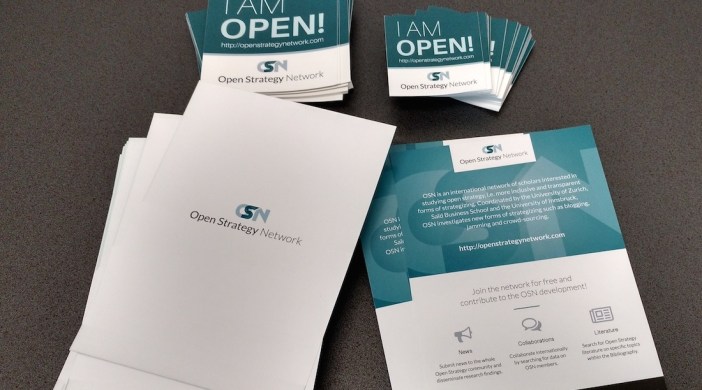
Fueled by new digital technologies and by the perceived success of concepts such as ‘open innovation’, we can observe a growing interest in open forms of organizing more generally both among practitioners as well as among organization scholars (see also the wiki-based course on the matter). One such new field representing the interest in organizational openness is the realm of strategy research under the label of ‘Open Strategy’. The recently launched online community platform ‘Open Strategy Network‘ tries to connect and foster exchange among scholars interested in this emerging phenomenon.
The platform has been initiated by David Seidl and Violetta Splitter (University of Zurich) together with Richard Whittington (Oxford University) and myself. Registered users will be able to contact each other and browse through open strategy articles listed in the bibliography. Currently, the number of entries in the bibliography is limited but several articles on different facets of open strategy are already in the pipeline – for instance, Long Range Planning will soon feature a special issue on ‘Open Strategy – Transparency and Inclusion in Strategy Processes‘.
To receive updates from the Open Strategy Network on new publications and other news related to open strategy research please follow @OpenStrategyNet on Twittter and Facebook or subscribe to the newsfeed of openstrategynetwork.com.
Metaphors help t o understand organizations from different perspectives. Over the past 20 years the dominant metaphor for understanding organizational improvisation has been that of the Jazz band (Kamoche et al., 2003). However, this focus on one metaphor implies that we have forgotten an important lesson that Morgan (1997) taught us about metaphors: “a way of seeing is also a way of not seeing”. Continue reading “Organizational Improvization beyond the Jazz Metaphor: Indian Music and Music Therapy”→
This research essay is authored by Hannes Henzinger, student in the master program Organization Studies at Universität Innsbruck.
“The intuitive mind is a sacred gift
and the rational mind is a faithful servant.
We have created a society that honors the servant
and has forgotten the gift.” (Albert Einstein)
A common narrative in today’s organization and management literature is that this world, especially the world of business, has become increasingly complex and unpredictable. Not just the scope, also the velocity of change has increased. Such a dramatic shift in the image of the environment seems to ask for an abandonment of old organizational practices. Not just bureaucracy seems outdated. Even stable strategies, routines, and planning are running the risk of falling short of what is needed to react timely and adaptively in this new environment. This narrative calls for a reconstruction of the practice of organizing, “new models and metaphors are needed for organizing” (Barrett, 1998, p. 605). The metaphor of a jazz band, introduced by Karl Weick, is a particularly catchy one. With an allusion to peak performance, like a “flow” experience (Csikszentmihalyi, 1990), it elegantly charms the reader into seeing jazz aspects in organizing and decision making. Beyond the lessons that are elaborated on in the article by Barrett (1998) the metaphor offers two further potentially valuable aspects, that, although foundational to the metaphor, often go unnoticed: the role of intuition in organizing and decision making and playful practice. Continue reading “Organizing Intuition and Playful Practice: The Jazz Band Metaphor Revisited”→
In some Organization Studies courses, students are required to write a short research essay, addressing one focused question or thesis related to the course topic. These essays are distinct from ‘ordinary’ seminar or term papers not only due to their short length but also because the students are encouraged to take a clear, maybe even provocative stance.
Reading these essays, Richard Weiskopf and I have regularly encountered works that were of such excellent quality that we think it would be a waste to just grade them. Rather, we have – and will continue to do so – asked authors of such essays to share them with a wider audience here at the ConJunction Community Blog.
The first two essays in what we hope will be an ongoing series, have been provided by Cäcilia Bart and Hannes Henzinger. While both essays deal with Jazz as a metaphor for organizing, they contribute quite different insights. Stay tuned for these and future student essays.
When presenting in class, students in my courses are required to include at least one “interactive part” involving their fellow class mates. The main goal of this rule is to foster experience-based learning and to make student presentations more varied. How the students involve their colleagues is entirely up to them; collateral benefit of this openness is that I profit immensely from the creativity and diversity of ideas and techniques put forward by the students.
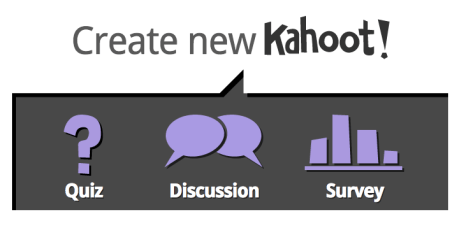
Over the course of the past semester, for instance, I not only saw but experienced various tools for digital interactivity – some of which were really helpful in raising attention levels and understanding. Please find below a selection of three such digital tools, all of which are browser-based and work on laptops, tablets and smartphones alike:
Von 2. bis 4. Mai findet in Berlin bereits zum 10. Mal die als Blogger-Konferenz gestartete re:publica statt, die mittlerweile zur wohl größten Digitalkulturkonferenz Europas geworden ist. Das Themenspektrum ist dementsprechend breit und gemeinsam mit Volker Grassmuck, Kathrin Passig und Monic Meisel bin ich bei einem Panel rund um Bewegungen und digitale Communities sowie mit ihnen verbundene, formale Organisationen mit an Board. Aus der Ankündigung des martialisch betitelten Panels “Clash of Cultures“:
Wikipedia, Freifunk und der öffentlich-rechtliche Rundfunk – drei Wissensinstitutionen, die dem Gemeinwohl, der res publica verpflichtet sind. So unterschiedlich sie sind, besteht das Verhältnis von Basis zu Institution jeweils aus den drei Schritten: Beauftragen, Bezahlen, Begutachten.
Zur Einstimmung auf die re:publica sei an dieser Stelle noch auf das Video meines letztjährigen Vortrags zur “Bewilligungskultur im Netz” verwiesen:
The overall rationale for the structure of the course follows the imperative formulated by Tkacz (2012: 404, PDF) in his “critique of open politics”:
To describe the political organisation of all things open requires leaving the rhetoric of open behind.
As a consequence, the lecture part of the course is organized around different aspects or dimensions of organizational openness such as boundaries, transparency, participation or emergence. The respective readings only peripherally address the issue of openness but rather shall provide the building blocks for arriving at a more precise and theoretically grounded understanding of openness.
The first Organization Studies ConJunction – Students and Alumni Day 2016 will take place on November 25th, 2016 at the SoWi-Campus, University of Innsbruck.
This day is a unique opportunity to connect with current and former fellow students of Universität Innsbruck’s Organization Studies (OS) Master program, to share experiences, to gain new and interesting insights into OS-topics and mainly, to spend a good time together in a relaxed atmosphere.
Inquiries should be sent to osconjunction@uibk.ac.at. Further details on the event will be posted on this blog.




 At the end of March I was invited speaker at a workshop on “

 The first


