Im Wiener Museumsquartier, Raum D, findet von 19.-26. Oktober 2026 die diesjährige Demokratiewoche zum Thema “Wissen Macht Demokratie” statt. Jeden Tag gibt es in diesem Zeitraum Vorträge und Diskussionsveranstaltungen. Ich selbst darf Freitag, 23. Oktober um 16 Uhr zum Thema “Überwachungskapitalismus und Demokratie” sprechen:
Shoshana Zuboff beschreibt den „Überwachungskapitalismus“ als eine „Mutation des Kapitalismus“, die auf der Umwandlung menschlicher Erfahrung in Verhaltensdaten beruht und eine neue Form von „instrumentärer Macht“ hervorbringt. Diese greift nicht nur die Würde des Menschen an, sondern gefährdet auch die Demokratie und höhlt Grundlagen kritisch-reflektierter Vernunft und Teilhabe aus. Der Vortrag erörtet Zuboffs Konzept und zeigt einige Fluchtlinien für eine demokratisierende Öffnung und Transformation auf.
Dear all, we are delighted to invite you to the 10th Organization Studies ConJunction Day which will take place on November 27, 2026, at 3 p.m. This year´s ConJunction Day will explore the timely theme “Organizing (Post-)Truth in the Era of AI”.
We look forward to welcoming you! More details will follow soon.
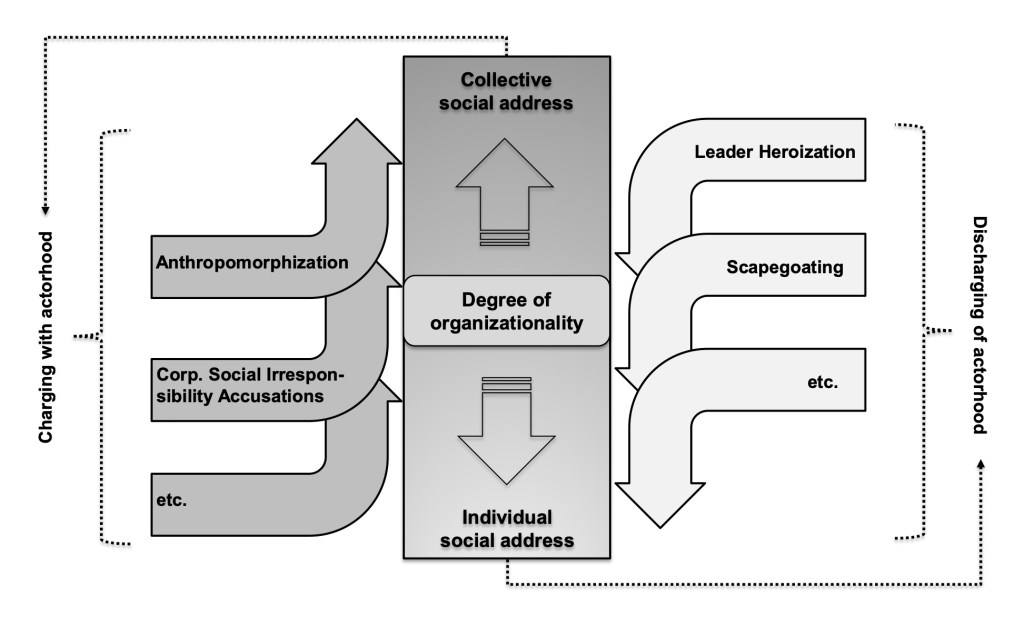
The organizationality framework offers an explanation how collective social addresses are charged with and discharged of actorhood.
Over ten years ago, Journal of Management Studies published Dennis Schoeneborn and my article on “Fluidity, Identity & Organizationality: The Communicative Constitution of Anonymous.” It turned out to become not only my most cited piece of scholarly work but really started a conversation on how we should conceptualize organization: as an entity (organization), as a process (organizing) or rather as property of social phenomena (organizationality).
Not long after the article had been published, Dennis and I started to work on a theoretical follow-up to spell out what we had only claimed but not fully conceptualized: understanding organisation as a matter of degree. Over seven years since we started this endeavour and after teaming up with David Seidl, I am extremely happy and proud that “Toward a Theory of Organizationality: A Gradual View on Collective Actorhood” has been accepted for publication at Organization Theory and is available open accessas a preprint version. The abstract summarizes our main points:
This paper addresses a central dilemma in organizational theory of how to conceptualize organization in a way sufficiently specific to distinguish it from other social phenomena yet sufficiently flexible to account for new organizational forms. Traditionally, there has been a split between scholars advocating a narrow understanding of organizations as entities and scholars arguing for a broader understanding of organizing as a processual phenomenon. While an overly narrow approach risks rendering organization studies irrelevant by failing to account for new organizational phenomena, an excessively broad view risks blurring the distinction between organization and sociality in general. To resolve this dilemma, we advance a third-way approach based on the concept of organizationality – a gradual notion of organization, understood as a quality that social collectives may possess to a higher or lower degree. In particular, we develop the contours of a theory of organizationality grounded in a gradual understanding of collective actorhood. Higher and lower degrees of organizationality, in turn, depend on practices of attributing actorhood to a collective or to an individual social address. By proposing collective actorhood as the main axis of organizationality that can vary in degree over time, we offer a theoretical framework that preserves the specificity of organization as a concept while accounting for a broader range of new organizational phenomena, as well.
At the same time, this is the perfect occasion to once more point toward the open call for papers in Business & Society on “Collective Actorhood and Organizationality” with the deadline for submissions set at September 30, 2026.
Am Institut für Organisation und Lernen (IOL) suchen wir aktuell zwei studentische Mitarbeiter/innen für das anstehende Wintersemester:
Der Arbeitsbereich Controlling sucht eine/n studentische/n Mitarbeiter/in für 4h/Woche (i.e., ein Vormittag od. Nachmittag). Die Bezahlung beträgt ca. 270 Euro im Monat. Es geht um eine Unterstützung bei laufenden Forschungsprojekten und allgemeiner administrativer Arbeit. Bewerbung (mit CV) bis spätestens 25.9. per Email an martin.messner@uibk.ac.at.
Der Arbeitsbereich Organisation sucht eine/n studentische/n Mitarbeiter/in für 5h/Woche. Es geht um Unterstützung in Forschung und Lehre, hier insbesondere auch Online-Begleitung von Einführungsveranstaltungen. Die Bezahlung beträgt ca. 340 Euro im Monat. Bewerbung (mit CV) bis spätestens 25.9. per Email an leonhard.dobusch@uibk.ac.at.
// English version //
At the Department of Organization and Learning (IOL), we are currently seeking two student assistants for the upcoming winter semester:
The area of Controlling is looking for a student assistant to work 4 hours per week (i.e., one morning or one afternoon). The pay is approximately 270 euros per month. The position involves assisting with ongoing research projects and general administrative work. Please submit your application (including a resume) by September 25 at the latest via email to martin.messner@uibk.ac.at.
The area of Organization is seeking a student assistant for 5 hours per week. The role involves providing support in research and teaching, particularly in the form of online assistance with introductory courses. The pay is approximately 340 euros per month. Please submit your application (including a resume) by September 25 at the latest via email to leonhard.dobusch@uibk.ac.at.