The Alumni-Team of the Master Program Organization Studies and the Transferstelle Wissenschaft – Wirtschaft – Gesellschaft invite to the 2nd Organization Studies ConJunction Students and Alumni Day on November 24, 2017, 3:00 p.m., Kaiser-Leopold-Saal, Faculty of Theology, University of Innsbruck. And this is the program under the headline of “Organizing and Entrepreneurship”: Continue reading “Program of the 2nd OS ConJunction Students and Alumni Day: »Organizing and Entrepreneurship«”→
In the wake of new digital technologies, organizations rely increasingly on contributions by external actors to innovate or even to fulfill their core tasks, including strategy-making processes. These external actors may take the form of crowds, where actors are isolated and dispersed, or of communities, where these actors are related and self-identify as members of their communities. While we know that including new actors in strategy-making may lead to tensions, we know little about how these tensions differ when either crowds or communities are concerned. Investigating this question by analyzing open strategy-making initiatives conducted by two non-profit organizations (Creative Commons and Wikimedia), we find that tensions with communities may be resolved with increasing openness in strategy-making, while crowds are better compatible with more exclusive strategy-making practices.
The full text of the article is available at the journal’s website. As usual, please send me an e-mail in case you are interested but your institution does not provide access to the journal.
In this article, we examine how non-membership organizations that claim stewardship over a transnational public or common good, such as the environmental or digital commons, develop combinations of formal and informal recursivity to develop and maintain regulatory conversations with their dispersed user communities. Based on a case study of Creative Commons, an organization that developed what have become the most widely used open licenses for digital content, we show how rhetorical openness to informal feedback from legitimacy communities in different sectors and countries can improve the feasibility and diffusion of standards. However, as long as the standard-setter’s methods of making decisions on the basis of such feedback remains opaque, its communities are likely to raise accountability demands for more extensive ex post justifications.
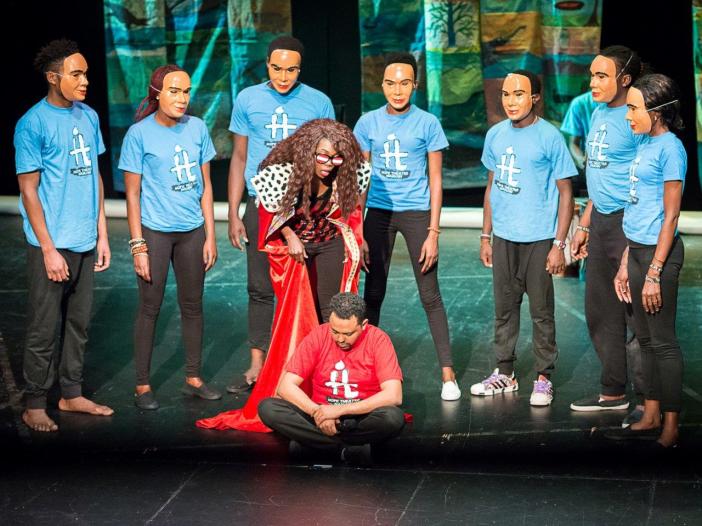
Ein Veranstaltungshinweis für alle, die sich für (Anti)Diskriminierung interessieren. Aus der Einladung zur Veranstaltung (PDF):
Diskriminierung bedeutet Abgrenzung, Abwertung und Ausgrenzung von Anderen. In der Revue THE OTHERS OF THE OTHERS, die Stephan Bruckmeier und Margit Niederhuber im Auftrag der Gleichbehandlungsanwaltschaft mit dem Hope Theatre Nairobi produziert haben, findet eine Auseinandersetzung mit Diskriminierungsthemen statt – gespielt, gesungen und getanzt.
In Innsbruck gastiert die Revue am 16.10.2017 um 19 Uhr im VIER UND EINZIG, Hallerstraße 41. Anmeldung ist erforderlich unter ibk.gaw@bka.gv.at bis 9. Oktober 2017.
In a recent article (PDF) published in the leading German management research journal Managementforschung, Waldemar Kremser (Radboud University Nijmegen), David Seidl, Felix Werle (both University of Zurich) and I have tried to systematically compare the more recent stream of literature on open strategy-making with previous studies on open innovation. For doing so, we operationalized organizational openness in communication terms, guided by a Luhmannian understanding of organizations as communication. The abstract of the paper reads as follows: Continue reading “New Publication: »A Communication Perspective on Open Strategy and Open Innovation«”→
In diesem Kontext durfte ich auch in einem kurzen Interview die Kernerkenntnisse und Ableitungen des Beitrags in Videoform zusammenfassen. Entscheidend für Regulierung ist der Fokus auf Gebühren, kurz: Follow the fees!
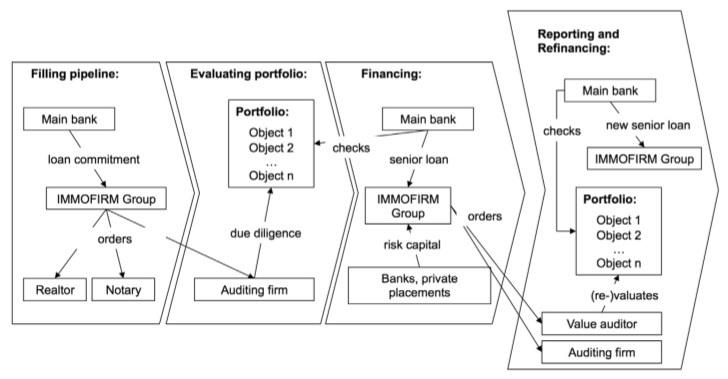
Quelle und Link zum Beitrag, um den es geht: Botzem, S., & Dobusch, L. (2017). Financialization as strategy: Accounting for inter-organizational value creation in the European real estate industry. Accounting, Organizations and Society, im Druck.
Globalization and digitalization are keywords which characterize today’s society. The process of digitalization and dissemination of data has already found its way into education. It is one of the biggest concerns when talking about modernizations in educational systems (Dobusch & Heimstädt, 2016). One primary goal of recent education is to make knowledge accessible anywhere, anytime and for anyone. As a result education becomes egalitarian and contributes to the public’s welfare. In his educational ideal Humboldt already registered that it is the state’s duty to make knowledge available for everyone even for the poorest (Gaisbauer, Kaperer, Koch & Sedmak, 2013). Going one step further beyond open access for everybody the UNESCO has come up with the conception of Open Educational Resources (OER). “OER are teaching, learning, and research resources that reside in the public domain or have been released under an intellectual property license that permits their free use or re-purposing by others.” (Atkins, Brown & Hammond, 2007, p. 4).
What also came along with this Open Education Movement were Massive Open Online Courses (MOOCs) in the segment of higher education. Since 2008 these educational opportunities offered by universities and commercial organizations have shaped the educational infrastructure. The number of MOOCs has rapidly grown in the last ten years because educational institutions have to fulfill the needs of potential students and to meet the requirements of the fast changing educational market towards learner-centered and individualized learning methods. MOOCs are online courses which provide each person free access to university level education without paying a fee and without the need to fulfill certain admission requirements (Yuan & Powell, 2013). Though, at this point it raises the question: To what extent does the ‘Open’ in Massive Open Online Courses correspond to the ‘Open’ in Open Educational Resources or do MOOCs not overcome the hurdle of providing only Open Access instead of Open Education? Continue reading “The Simulacrum of Massive Open Online Courses representing Open Educational Resources”→