Parlagram visualisiert worüber das österreichische Parlament spricht

Ziemlich genau zwölf Jahre nach der Ankündigung des ersten Momentum-Kongresses 2007 ist daraus im September 2019 mit dem Momentum Institut das Experiment eines “Think Tanks der Vielen” hervorgegangen. Wie schon beim Kongress bin ich Mitgründer und versuche als wissenschaftlicher Leiter den Dialog und wechselseitigen Transfer zwischen Wissenschaft, Politik und Zivilgesellschaft zu unterstützen.

Als eines der ersten Projekte ist seit kurzem das Parlagram online verfügbar. Das Online-Tool macht die Debatten im österreichischen Nationalrat für die Vielen durchsuchbar. Worüber reden die gewählten Volksvertreterinnen und Volksvertreter im Parlament eigentlich? Welche Themen und Anliegen finden Gehör, was bleibt im wörtlichen Sinne unerwähnt?

Continue reading “Parlagram visualisiert worüber das österreichische Parlament spricht”

New Course Syllabus: »Organizing the Digital in the Public Sphere«

Last year our Faculty of Business and Management launched the new master’s program “Digital Business”. As part of this program I had the opportunity to design the course “Organizing the Digital in the Public Sphere”. From the syllabus, which I am happy to make available as a PDF download (licensed CC BY):

Digitalization is affecting not just private sector businesses but also the public sector. At the same time, the whole notion of “public” is changing in the course of ongoing digital transformations. By referring to the “Public Sphere”, this course seeks to capture both these dynamics. Consequently, the course comprises two main parts. The first part focuses on the digital transformation of public sector institutions such as public administrations, public service providers and public utilities. The second part addresses the public more broadly and looks at new forms of platform-based publics as well as provision of public goods with private means.

Didactically this is the first course that I designed following a point-counterpoint format: in each session two students will open with talks representing oppositional viewpoints on the subject before we enter into a joint plenary discussion of the readings.

Looking back on the Academy of Management Annual Meeting 2019 in Boston

At the AoM meeting in Boston together with the current chair of the SAP Interest Group, Sotirios Paroutis and my predecessor as PDW chair Katharina Dittrich (both from University of Warwick)

Recently I had been elected to the leadership track of the  Strategizing Activities and Practices (SAP) Interest Group in the Academy of Managment (AoM). This means that I will be responsible for co-organizing the interest group’s program at the Annual Meeting of the Academy of Management for the next five years, starting in 2020. So at this year’s Academy of Management Annual Meeting in Boston I was not only taking part in the academic program but also had several meetings preparing me for my duties in this regard. In 2020, my main responsibility will be to organize the various Professional Development Workshops (PDWs) of the Interest Group. In case you have ideas or proposals regarding this part of the meeting’s program, please do not hesitate to contact me.

Below is a list of my scholarly contributions at this year’s AoM Annual Meeting:

  • “From Programmatic to Constitutive Perspectives: Two Approaches to Studying Openness in Strategy and Beyond” in a Professional Development Workshop on “Open Strategy: Practices and Perspectives” (see slides below; slides of all contributors are available at the Open Strategy Network).

Continue reading “Looking back on the Academy of Management Annual Meeting 2019 in Boston”

New Book Chapter: »Alternating between Partial and Complete Organization«

Building upon a previous joint article on “Fluidity, Identity, Organizationality: The Communicative Constitution of Anonymous”, my co-author Dennis Schoeneborn and I dig deeper into issues related to the concept of “partial organizations” in a new book chapter entitled “Alternating between Partial and Complete Organization: The Case of Anonymous”. Specifically, the case of the hacker collective Anonymous illustrates that longer periods of ‘partialness’ may alternate with temporary punctuations, during which a social collective accomplishes a ‘completion’ of its organizationality. As a consequence, with our book chapter we seek to contribute to a processual and dynamic theory of partial organization, thereby applying a communication as constitutive of organization (CCO) perspective.

The chapter is part of the volume “Organization outside Organizations
The Abundance of Partial Organization in Social Life” (2019, Cambridge University Press), edited by Göran Ahrne and Nils Brunsson. A pre-print version of the Chapter is openly available as a PDF.

New Book Chapter: “The Relation between Openness and Closure in Open Strategy”

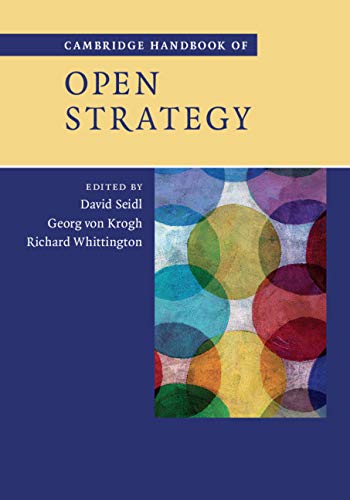
In any case, I would have been happy to contribute to the brand new “Cambridge Handbook of Open Strategy”, co-edited by David Seidl, (Universität Zürich), Richard Whittington (University of Oxford) and Georg von Krogh (ETH Zürich). Given that the chapter’s co-author is my sister Laura (Radboud University Nijmegen), I am even more proud about our contribution on “The Relation between Openness and Closure in Open Strategy: Programmatic and Constitutive Approaches to Openness”.  A short excerpt from the Introduction:

Two facets are all but universally present in current works on Open Strategy. First, while being aware of and addressing challenges and dilemmas associated with openness in strategy making (Hautz et al., 2017), increasing openness is mostly perceived as normatively good, as an ideal that should be achieved. […] Second, openness is mostly considered to be the opposite of closure, or at least the other endpoint of a continuum from closedness to various degrees of openness in terms of greater transparency or inclusion (Whittington et al., 2011).

Taken together, an affirmative perspective on openness as opposed to closure is central to a currently dominant programmatic approach, which is mainly concerned with putting openness into practice and unleashing its respective potential. However, as we will argue in this chapter, addressing many of the tensions or dilemmas observed in empirical endeavours to implement greater ‘openness’ could potentially benefit from another perspective, which understands openness (and closure) as a paradox (Putnam et al., 2016) where openness and closure appear contradictory but yet simultaneously depend on each other. Key for such a constitutive approach towards openness is that this paradox cannot be dissolved entirely but only addressed in a specific way, namely by legitimate forms of closure.

A pre-print version of the article is open access available at the Open Strategy Network, which features pre-prints of all chapters in the Handbook.

Looking back on the 35th EGOS Colloquium »Enlightening the Future« in Edinburgh

The annual Colloquium of the European Group of Organization Studies (EGOS) is a great opportunity to engage with a great variety of research communities. In 2019 University of Innsbruck’s department of organization and learning was represented with a record number of participants. Please find an overview of our contributions to this year’s EGOS Colloquium below.

Continue reading “Looking back on the 35th EGOS Colloquium »Enlightening the Future« in Edinburgh”

New Article: »Dynamics of the Sharing Economy between Commons and Commodification«

The essay “Dynamics of the Sharing Economy between Commons and Commodification” is based upon a conference paper presented at the conference “A Great Transformation? Global Perspectives on Contemporary Capitalisms” in 2017. It has now  been published in the most recent issue of Momentum Quarterly:

Revisiting scholarly debates around the weal and woe of the so-called “sharing economy,” this essay proposes a distinction between commons-based and market-based forms of the sharing economy. Applying a Polanyian lens to these two types of sharing economy not only reveals countervailing developments between commons and commodification depending on the type of platform governance; in addition, such a perspective also directs attention to externalities regularly associated with the expansion of market logics in previously nonmarket territories.

Check out the open access full text.

Konferenz zur “Zukunft der Prognostik” in Erlangen

Am Internationalen Kolleg für Geisteswissenschaftliche Forschung der Friedrich-Alexander Universität Erlangen-Nürnberg findet von 23.-24. Juli eine Konferenz zum Thema “Die Zukunft der Prognostik: Was wir heute und morgen vorhersagen können”. Hier der Link zum Programmplakat als PDF. Weitere Informationen und Registriertungsmöglichkeit unter ikgf.uni-erlangen.de/zukunft-der-prognostik.

Diskussion zu Wirtschaftswissenschaftlicher Lehre an HWR Berlin: “Fit für die Zukunft?”

Am 3. Juni 2019, 19:30-21:00 darf ich gemeinsam mit Larissa Bleckwehl (HR Business Partner) an der Berliner Hochschule für Wirtschaft und Recht zum Thema “Fit für die Zukunft? Was braucht die wirtschaftswissenschaftliche Lehre?” diskutieren (PDF der Ankündigung). Thema wird dabei unter anderem die Frage nach Pluralismus hinsichtlich Theorien und Methoden sein. Aus der Ankündigung der Veranstaltung:

Finanzkrise, Klimawandel und digitale Revolution: Die Welt befindet sich im Umbruch, doch in den Seminarräumen gilt business as usual? Die wirtschaftswissenschaftliche Lehre wird von verschiedenen gesellschaftlichen Akteuren kritisiert – nicht nur in Deutschland. Sie sei realitätsfremd und einseitig. Braucht es deshalb mehr Pluralismus in den Wirtschaftswissenschaften, also eine Vielfalt der Disziplinen, der Perspektiven und Methoden?  Welche Kompetenzen soll das wirtschaftswissenschaftliche Studium heute vermitteln, damit die Studierenden gut vorbereitet sind für das Leben nach der Hochschule? Ist die HWR gut für die zukünftigen Herausforderungen aufgestellt und was ist noch zu verbessern?

Re:publica 2019: Digitale Öffentlichkeit zwischen Sender-Silos, Public Value und öffentlich-rechtlichen Ökoystemen

Wie im letzten Jahr war ich auch 2019 bei der Digitalkonferenz re:publica in Berlin, um als Organisationsforscher und als Mitglied des ZDF Fernsehrats zu Themen rund um neue digitale Öffentlichkeiten sprechen. Konkret durfte ich einen Vortrag halten, bei zwei Panels und einem Live-Podcast mitdiskutieren.

Ganz allgemein stand die re:publica dieses Jahr unter dem Motto “tl;dr”, kurz für “too long; didn’t read” und neben dem wie üblich spannenden Vortragsprogramm waren es viele kleine Dinge, die mir 2019 besonders gut gefallen haben. So wurde dem Motto entsprechend der Doppelpunkt im Logo durch einen Strichpunkt ersetzt, es zog sich der Volltext des wohl bekanntesten “tl;dr”-Werks Moby Dick als Installation durch die Hallen und beim Konzert der Band Tubbe am zweiten Abend wurden deren Texte live auf der Bühne von einer Gebärdendolmetscherin quasi vorgetanzt. Außerdem gab es eine durchgehende Live-Lesung des ebenfalls schier endlosen und sehr unterhaltsamen Techniktagebuchs, das 2019 genauso wie ich mit “Neues aus dem Fernsehrat” für den Grimme Online Award nominiert ist. Im folgenden eine kurze Übersicht über meine re;publica-Auftritte dieses Jahr:

Continue reading “Re:publica 2019: Digitale Öffentlichkeit zwischen Sender-Silos, Public Value und öffentlich-rechtlichen Ökoystemen”