Currently, the Academy of Management (AoM) hosts its Annual Meeting in Boston. The meeting is mainly organized along various Divisions and Interest Groups and follows fairly standard conference formats such as paper sessions, panels (“Symposiums”) and round table sessions. In all of these sessions, topics, speakers and facilitators are defined in advance, establishing a clear hierarchy between session organizers and speakers on the one hand, and the audience on the other hand.
In today’s fast-paced business environment, organizations constantly seek methods that foster adaptability, responsiveness, and inclusivity in their strategic decision-making processes. One emerging trend is Open Strategy initiatives. Unlike traditional top-down strategies, open strategy promotes increased transparency, inclusion, and broad-based participation in strategic development, often facilitated by IT systems (Hautz et al., 2017; Tavakoli et al., 2017). However, as this openness scales, it becomes increasingly complex, leading to potential pitfalls that can hinder its execution, as evidenced by the Wikimedia Foundation (Laura Dobusch et al., 2019) and Premium Cola (Luedicke et al., 2017). Hautz et al. (2017) therefore outline the five dilemmas of process, commitment, disclosure, empowerment, and escalation. Interestingly, some companies are already reversing their open strategy approach in pursuit of greater control and profit from their innovations (Appleyard & Chesbrough, 2017).
Another prevalent trend is Agile working. Originating in software development, Agile methods prioritize flexibility, continuous improvement, and active stakeholder involvement. They are characterized by iterative development cycles and a swift response to change (Alsaqqa et al., 2020). Agile methods positively impact project success, efficiency, and stakeholder satisfaction in volatile and uncertain environments (Serrador & Pinto, 2015). The 15th State of Agile Report by Digital.ai (2022) reveals that 86% of Software Development and 63% of IT departments are working agile, with other departments like operations or production also seeing a significant increase from 2020 to 2021. Agile values align with Open Strategy on many occasions and provide tangible measures for their implementation.
The central thesis of this essay suggests that as open strategy is practiced more radically, its inherent challenges become increasingly pronounced. However, the principles and methods of Agile frameworks, known for their robust response to the complexities of software development and other areas, can offer valuable solutions to these open strategy pitfalls. This essay will introduce the values of Open Strategy and the challenges associated with scaling them in an organization. It will then explain how Agile methodologies handle these values and how Open Strategy could benefit from these practices.
As a worldwide, open and collaborative knowledge sharing platform, Wikipedia has largely replaced the need for physical encyclopedias for many. From children using it for their first school presentations to university professors and academics, the readership is broad and diverse. And since Wikipedia prides itself on being an open-for-anyone space for collaboration, you would think that the large community of editors and contributors should be similar in diversity, but this is not the case. While there are multiple dimensions of diversity that could be examined in the case of Wikipedia, gender is the most visible and prominent facet. But not only diversity among users is more scarce than expected, furthermore there is a lack of inclusivity of perspectives and alternative opinions, which in some cases can lead to misrepresentation. Recognizing the lack of diversity among editors and the resulting bias in the content displayed is crucial for making attempts to increase inclusivity in both areas, which according to Wikipedia’s principle of equality should be the goal of the organization and its vast community. Finding the causes for this exclusion is the next step. This essay will examine potential exclusionary effects of boundaries around and within Wikipedia and how they inhibit inclusivity for both contributors and content. In total, four boundaries and their potential for exclusion are discussed. The focus lies on the English version of Wikipedia to keep an appropriate scope.
Last week, Monica Nadegger, Katharina Zangerle, and Milena Leybold (University of Innsbruck, Department for Organization and Learning) traveled to the beautiful island Sardegna to meet for four days with around 2000 people at the Colloquium of the European Group of Organization Studies.
From the left: Monica Nadegger, Milena Leybold, Katharina Zangerle
I am very glad to announce that the article “Taking Individual Choices Seriously: A process perspective of self-selection in strategy work”, co-authored by Martin Friesl, Martin Brielmaier and myself, has been accepted for publication at Organization Theory and is already available online. Particularly the growing interest in open approaches to strategy, which at least formally invite broad audiences to participate in organizational strategy-making, was one of the reasons for writing this paper. Not just because an invitation to participate cannot hardly intrinsic motivation to actually contribute but also because inviting everyone does not guarantee that you will actually arrive at a more diverse and inclusive bunch of people (see also Dobusch et al., 2019). The abstract reads as follows:
An increasing body of work investigates the participation of a diverse set of actors in strategy making. We argue that extant research tends to gloss over a fundamental condition underpinning such participation: while participation may reflect a hierarchical mandate, insofar as it relates to the actual involvement of employees, it is the result of a process of self-selection. From this perspective, forms of participative strategizing are neither fully the outcome of deliberate top-down choice, nor do they form a random pattern that is subject to the whims of individual employees. Such forms of strategizing are rather, as we argue in this paper, based on an endogenous logic of whether and how an individual self-selects, and in turn involves her/himself in the process, or not. To conceptualize the broader phenomenon of strategy participation, we draw on practice theory to conceptualize how individuals knowingly choose to involve themselves in strategizing events and we develop in turn a process model of self-selection as an ongoing social accomplishment. This model elaborates different patterns of participation in strategy making (stabilizing and shifting trajectories) with variable emergent outcomes. We end the paper by discussing the implications of our theorizing for ongoing research on open and participatory strategizing, and for the body of work on strategy as practice.
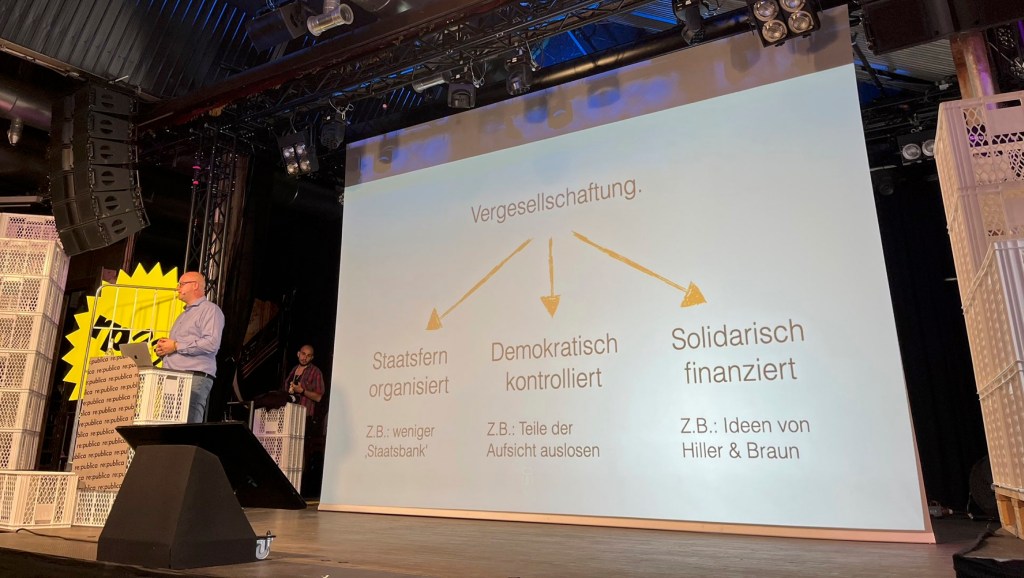
Die jährlich in Berlin stattfindende re:publica ist wahrscheinlich eine der spannendsten und inklusivsten Digitalkonferenzen und für mich jedes Jahr ein Highlight in meinem Konferenzkalender. Dieses Jahr war ich mit einem Vortrag und als Teil eines Panels im Programm vertreten.
In meinem Vortrag habe ich versucht, den Bogen von der – auch in Österreich im Zuge der Einführung einer Haushaltsabgabe gerade aktuellen – Rundfunkbeitragsdebatte hin zur Vergesellschaftungsdebatte zu spannen, indem ich öffentlich-rechtliche Medien als wichtiges Beispiel für vergesellschaftete Organisationsformen unserer Zeit in den Blick genommen habe (Slides als PDF-Download).
The Department of Organisation and Learning is seeking to hire a Research Assistant (PhD position) in the area of management control/governance, starting in September 2023. Application deadline is June 20, 2023.
Die Komplexität und zunehmend enge Kopplung vieler Lieferketten stellt eine große logistische Herausforderung für Leitunternehmen dar. Eine weitere Herausforderung besteht darin, dass Leitunternehmen — gedrängt durch Konsument:innen, eine kritische Öffentlichkeit und gesetzgeberische Maßnahmen wie die Lieferkettengesetze — stärker als bisher Verantwortung für Arbeitsstandards in ihren Zulieferbetrieben übernehmen müssen. In diesem Beitrag diskutieren wir einen neuen Ansatz, mit dem Leitunternehmen versuchen, diese Herausforderungen zu bearbeiten: die algorithmische Vorhersage von betriebswirtschaftlichen, aber auch ökologischen und sozialen Risiken. Wir beschreiben die technischen und kulturellen Bedingungen für algorithmische Vorhersage und erklären, wie diese — aus Perspektive von Leitunternehmen — bei der Bearbeitung beider Herausforderungen hilft. Anschließend entwickeln wir Szenarien, wie und mit welchen sozialen Konsequenzen algorithmische Vorhersage durch Leitunternehmen eingesetzt werden kann. Aus den Szenarien leiten wir Handlungsoptionen für verschiedene Stakeholder-Gruppen ab, die dabei helfen sollen, algorithmische Vorhersage im Sinne einer Verbesserung von Arbeitsstandards und Workers’ Voice weiterzuentwickeln.
Der Beitrag ist Teil eines von Thomas Haipeter und anderen herausgegebenen Sammelbands “Soziale Standards in globalen Lieferketten: Internationale Richtlinien, unternehmerische Verantwortung und die Stimme der Beschäftigten”, der bei Transcript als Open-Access-Volltext verfügbar ist.
“Open source, file-sharing, crowdfunding, liking – die Welt der digitalen Kommunikation ist voller Wirtschaftspraktiken, die dem Geben, Nehmen und Teilen näher sind als dem Verkaufen, Kaufen und Leihen.”
Mit diesem Satz beginnen Michael Hutter und Birger P. Priddat die Einleitung des von ihnen herausgegebenen Sammelbands “Geben, Nehmen, Teilen: Gabenwirtschaft im Horizont der Digitalisierung,” der im Anschluss an zwei Tagungen zum Thema im April 2021 und März 2022 erschienen ist und unter anderem Beiträge von Jasmin Schreyer oder Günther Ortmann enthält.