Join our inspiring February: upcoming keynote and mini-workshop!

On February, 19-20, organization scholars from Innsbruck will host a small workshop titled “Communication as a Practice – Bridging Communication and Practice Perspectives in Organization Studies”. In the context of this workshop, our three international guests offer a great program open to everyone interested! Come and join us for a fantastic keynote and an insightful workshop session!

Continue reading “Join our inspiring February: upcoming keynote and mini-workshop!”

Five points I tell my students about citing and using Wikipedia

Foto: veryinformed.com at unsplash.com

While most academics and journalists, just like everybody else, heavily relies on Wikipedia for both private and professional purposes, it is quite common in among both these groups to scold anyone who openly admits doing so. For example, many lecturers tend to make fun of students citing Wikipedia and pride themselves in educating them that “Wikipedia is not a source” and, thus, cannot be cited in a seminar paper.

I not only strongly disagree with both tone and substance of such statements, but I regularly have to deal with insecurity and uncertainty among students with respect to the proper use of Wikipedia. The following list presents the five main points I try to bring across in such situations.

Continue reading “Five points I tell my students about citing and using Wikipedia”

Festrede zu “Reform und Zukunft des öffentlich-rechtlichen Rundfunks” beim Otto-Brenner-Preis 2023

In der Festrede anlässlich der Verleihung der Otto-Brenner-Preise für kritischen Journalismus 2023 habe ich in der laufenden Debatte eine provokant-optimistische These vertreten: Die besten Zeiten öffentlich-rechtlicher Medien liegen noch vor uns.

Das Manuskript meiner Rede ist in voller Länge bei Netzpolitik.org in der Reihe “Neues aus dem Fernsehrat” erschienen.

Medieninterviews und Erklärstück zur Krise von René Benkos Signa-Gruppe [Updates]

Wird Signas Elbtower in Hamburg fertig gebaut werden? (Foto: Uwe Rohwedder, CC BY-SA 4.0)

Hauptgrund für mein Interesse am Geschäftsgebaren der in Innsbruck ansässigen Signa Holding sowie deren weitverzweigtem Geflecht an Unternehmensbeteiligungen ist meine Forschung zu finanzialisierten Geschäftsmodellen im Immobiliensektor. Anlässlich der jüngsten wirtschaftlichen Turbulenzen der Signa-Gruppe, habe ich im Moment Magazin versucht, einige häufige Fragen zum Fall so einfach wie möglich zu beantworten:

  • Warum ist René Benkos Signa-Gruppe in wirtschaftlichen Schwierigkeiten?
  • Warum steckt sie offenbar in größeren Schwierigkeiten als andere Immobilienunternehmen?
  • Warum fällt es Signa so schwer, neue Kapitalgeber zu finden?
  • Wer zahlt eigentlich am Ende drauf, sollte Signa Pleite gehen?

Außerdem habe ich mich in einer Reihe von Medieninterviews bemüht, die Hintergründe zu erklären und Einschätzungen zur weiteren Entwicklung abgegeben:

Continue reading “Medieninterviews und Erklärstück zur Krise von René Benkos Signa-Gruppe [Updates]”

New Article in The Conversation: “Why young workers are leaving fossil fuel jobs – and what to do if you feel like ‘climate quitting’”

Credit: Documerica on Unsplash

Increasingly, we can observe employees leaving a job due to concerns about their employer’s impact on the climate or because you want to work directly on addressing climate issues. Together with Grace Augustine (University of Bath), I have published an article in The Conversation on this phenomenon, often referred to as “climate quitting”:

If you’re contemplating leaving your job over climate concerns, you’re not alone. Half of Gen Z employees (people born between the late 1990s and early 2010s) in the UK have already resigned from a job due to a conflict in values. And 48% of people aged 18–41 say they are willing to take a pay cut to work for a company that aligns with their sustainability values.

Check out the whole article “Why young workers are leaving fossil fuel jobs – and what to do if you feel like ‘climate quitting’” over at The Conversation.

“Capable of anything, culpable for nothing”: Last Week Tonight with John Oliver on McKinsey

Screenshot Last Week Tonight on McKinsey
Screenshot of Last Week Tonight segment on “McKinsey” (at about 25:36)

John Oliver’s Last Week Tonight with its well-researched and in-depth segments of journalism in satire’s clothing regularly manages to escape the 24-hour news cycle and instead set the agenda themselves. And if John Oliver takes on large consulting firms in general and McKinsey in particular, it is a must-watch for any student and scholar of management and organization studies. Check it out:

I would have enjoyed this piece very much, hadn’t it been all too accurate a depiction of systemic deficiencies in our contemporary corporate world. And while I really applaud the way the segment demonstrates that the problem with McKinsey is not one of “bad apples” but rather systemic, indeed, it does not really offer suggestions on how to improve the situation.

Continue reading ““Capable of anything, culpable for nothing”: Last Week Tonight with John Oliver on McKinsey”

EGOS 2024 Call for Short Papers: »Reorganizing Knowledge Practices in the Digital Era: Driven by Data, Out in the Open?«

The 40th EGOS Colloquium will take place from July 4-6, 2024, in Milan, Italy, and I am very happy to co-convene a sub-theme with Anne K. Krüger (Berlin-Brandenburg Academy of Sciences and Humanities) and Neil Pollock (University of Edinburgh Business School, UK). Please find the Call for Short Papers (about 3.000 words) of sub-theme 61 on “Reorganizing Knowledge Practices in the Digital Era: Driven by Data, Out in the Open?” below, submission deadline is January 09, 2024. Please also have a look at the submission guidelines.

Organizations produce, offer and structure knowledge that not only provides us with new insights but also triggers new developments. They display information that is supposed to support decision-making of people, enterprises, or politicians ranging from statistic reports, e.g. on demographic developments (Desrosières 1998), evaluation, e.g. of the credit-worthiness of individuals and nation states (Besedovsky 2018; Kiviat 2019) or of the performance of hospitals (Reilley and Scheytt 2019) and prisons (Mennicken 2013) to rankings of start-ups (Pollock and D’Adderio 2012), universities (Espeland and Sauder 2016; Wilbers and Brankovic 2021) or entire cities (Kornberger and Carter 2010). Much of our “knowledge about the world” is provided by organizations and highly organized processes. Particularly in times of perceived uncertainty and existential environmental threats (Bacevic 2021) such knowledge is having a crucial effect on our understanding of social problems and possible solutions.

Yet, in light of mounting demands for open access, open source, open data and open science (Bacevic and Muellerleile 2018; Dobusch et al., 2023) as well as increasing accumulation of mass data and their automated analysis (Crawford 2021), digitization presents a crucial crossroad for organizational knowledge production. These developments reorganize the ways how and which kind of knowledge is produced and offered. They not only amplify the possibilities of knowledge production in organizations and of access to knowledge through organizations but also allow for entirely new and very diverse forms of organizing knowledge creation and distribution, ranging from algorithm- and AI-based to volunteer- and crowd-driven. They furthermore influence what counts as knowledge, who has the authority to provide knowledge and how this knowledge informs our decisions and perception of what counts, e.g. as a trustworthy seller (Kornberger et al. 2017), as excellent science (Krüger and Petersohn 2022) or simply as good music (Alaimo and Kallinikos 2020).

Continue reading “EGOS 2024 Call for Short Papers: »Reorganizing Knowledge Practices in the Digital Era: Driven by Data, Out in the Open?«”

Ö1-Radiokolleg zum Thema “Unser Geld: Wie umgehen mit Schulden?”

Das Ö1-Radiokolleg dreht sich diese Woche um das Thema “Unser Geld: Wie umgehen mit Schulden?”. In der zweiten Folge durfte ich vergleichsweise ausführlich über (unvermeidbare) Sozialisierung von Verlusten bei Insolvenzen sowie die verzögerte Wirkung von Leitzinserhöhungen für Unternehmenspleiten sprechen. Einer von mehreren O-Tönen:

“Es wird eine Zeit dauern, bis die bereits erfolgten Zinserhöhungen sich auch auswirken, weil die Unternehmen ja auch längere Laufzeiten bei ihren Krediten haben und das ganze erst dann schlagend wird, wenn der Kredit ausläuft und refinanziert werden muss, und dann auf einmal die höheren Zinskosten aber nicht unbedingt mit höheren Einnahmen korrespondieren. Das ist auch der Grund, warum man hier auch Kaskaden von Insolvenzen sehen könnte, zum Beispiel im Bereich der Immobilienwirtschaft. Warum? Wir erleben derzeit, dass im Handel, als Spätfolge von Corona, aber auch durch den allgemeinen Strukturwandel hin zum Online-Handel, diese enorm hohen Mieten, die im Bereich von guten Lagen verlangt werden, einfach für Handelsunternehmen nicht mehr refinanzierbar sind. Das bedeutet, wir sehen hier Pleiten von Handelsunternehmen oder auch nur einen Rückzug aus bestimmten Lagen, und das wird dazu führen, dass in den nächsten zwei, drei Jahren, Immobilienbesitzer vor dem Problem stehen werden, dass sie keine Nachmieter finden, die ihre Mieten in den gewünschten Höhen erzielen. Was aber dann wiederum bedeutet, dass die Mieten sinken. Und wenn die Mieten sinken, lässt sich die Bewertung von Immobilien nicht mehr aufrecht erhalten. Was bedeutet, meine Immobilie wird weniger wert. Der Kredit geht aber nicht weg, der verschwindet nicht. Und wenn ich diesen Immobilienkredit dann refinanzieren muss, meine Immobilie aber weniger wert ist, als zuvor, dann wird das nicht mehr funktionieren. Und dann führen quasi die Handelspleiten zu Beginn zu Immobilienpleiten im nächsten Schritt.”

Die ganze Folge ist noch eine Woche zum Nachhören online. (Archiv-Downloadlink)

Call for Papers: 4th OT Winter Workshop at the University of Innsbruck

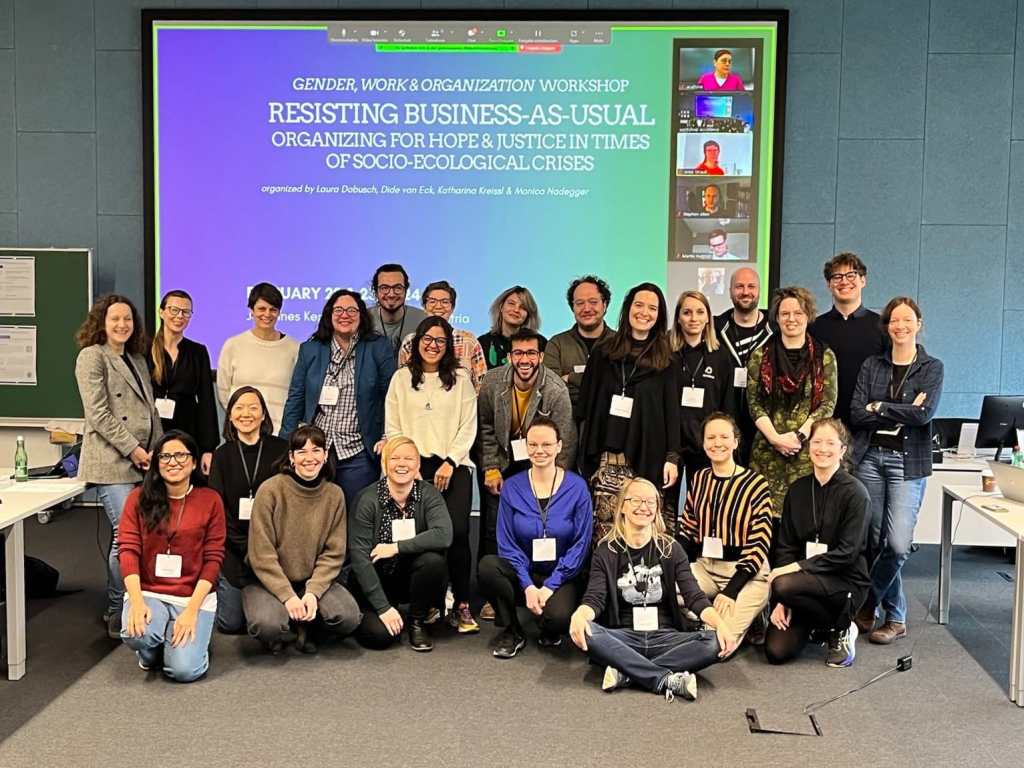
We are happy to announce that we will host the 4th OT Winter Workshop from February 6-8, 2024, at the University of Innsbruck. The OT Winter Workshop aims to advance research on organizational theory and further develop potential submissions to the journal “Organization Theory” (OT). The workshop will offer detailed coaching and hands-on feedback sessions as well as plenary sessions on crucial topics with regard to developing and writing theory with the members of the OT Editorial board.

Continue reading “Call for Papers: 4th OT Winter Workshop at the University of Innsbruck”