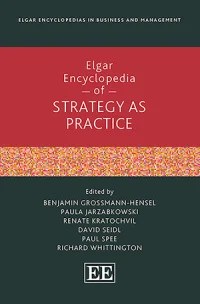
Together with three (former) doctoral students of mine, I had the honor to contribute three quite foundational entries to the brand new Edward Elgar Encyclopedia of Strategy as Practice, edited by Benjamin Grossmann-Hensel, Paula Jarzabkowski, Renate Kratochvil, David Seidl, Paul Spee, and Richard Whittington.
»Organization« (with Alwin Baumhöver):
The ontological question of what defines an organization has not been a central theme in strategy-as-practice (SAP) research (Kuhn, 2021), similar to more traditional strategy research that mostly takes organization for granted, as well. Yet, given the flat ontology of practice-theoretical approaches in general, the (re-)constitution of organizational phenomena from an SAP perspective can be conceptualized in the same manner as any social formation, based upon ongoing, patterned, and socially situated human activities (Schatzki, 2006). Building upon these foundations, one could even go so far to posit that what makes a social formation organizational in particular, is that its constituting bundle of interrelated sociomaterial practices is, at least to some degree, coordinated or driven by practices labelled as ‘strategic’ or ‘strategy-making’.
»Practices« (with Milena Leybold):
Until today, SAP scholarship is driven by the understanding of practice as a “set of doings” (Schatzki, 2002). Accordingly, SAP research aims to bridge the gap between “the theory of what people do and what people actually do” (Jarzabkowski, 2004, p. 529) by conceptualizing strategy as practice – something that people do instead of a stable plan or rigid concept an organization has (Jarzabkowski et al., 2007). Thereby, SAP scholarship differentiates between strategy praxis and practices (Jarzabkowski, 2004; Whittington, 2006). Praxis is understood as the situated, strategically consequential activity and actual work of strategy – also termed “strategy-making” or “strategizing” (Vaara & Whittington, 2012). Practices, on the other hand, are “[c]ognitive, behavioural, procedural, discursive, motivational and physical practices that are combined, coordinated and adapted to construct practice” (Jarzabkowski et al., 2007, p. 11).
»Participation« (with Monica Nadegger):
While participation is a key phenomenon in strategy formulation and implementation (Laine & Vaara, 2007), the opening and closing of participation in strategizing for a diverse set of actors creates new dilemmas (Dobusch et al., 2019; Hautz et al., 2017). On the one hand, participation is crucial for commitment, satisfaction, and quality in strategy-making and implementation and in fostering firm renewal and new capabilities (Friesl et al., 2023; Laine & Vaara, 2015; Tavella, 2021). On the other hand, organizations face increasing complexity and slower or inhibited decision-making capacity when strategizing with a diverse set of actors, and participants themselves experience the burden of strategy work as they become subjects to pressure, power, and control anchored in the strategizing discourse (Hautz et al., 2017; Vaara et al., 2019).
In case you are interested but lack access to the Edward Elgar Encyclopdia of Strategy as Practice, I am happy to provide you with a copy of the full entries.

