Opening Keynote on ‘Science (Communication) and Wikipedia: Potentials and Pitfalls’

Recently I had the honor of providing the opening keynote to the conference “Enhancing the voice of science on Wikipedia: How universities can collaborate with the online encyclopedia in science communication”, taking place from April 9–11, 2024, at University of Innsbruck.

I seized the opportunity to reflect on the following questions:

  • How ‘scientific’ is Wikipedia?
  • How important is science for Wikipedia?
  • How important is Wikipedia for science?
  • How important is Wikipedia for our common knowledge?
  • What are potentials when science communication meets Wikipedia?
  • What are the pitfalls?
  • Is it worth it?

Please check out the video recording above and the slides below.

Recap of the Workshop “Resisting Business-As-Usual” – Feb 23-24, JKU Linz

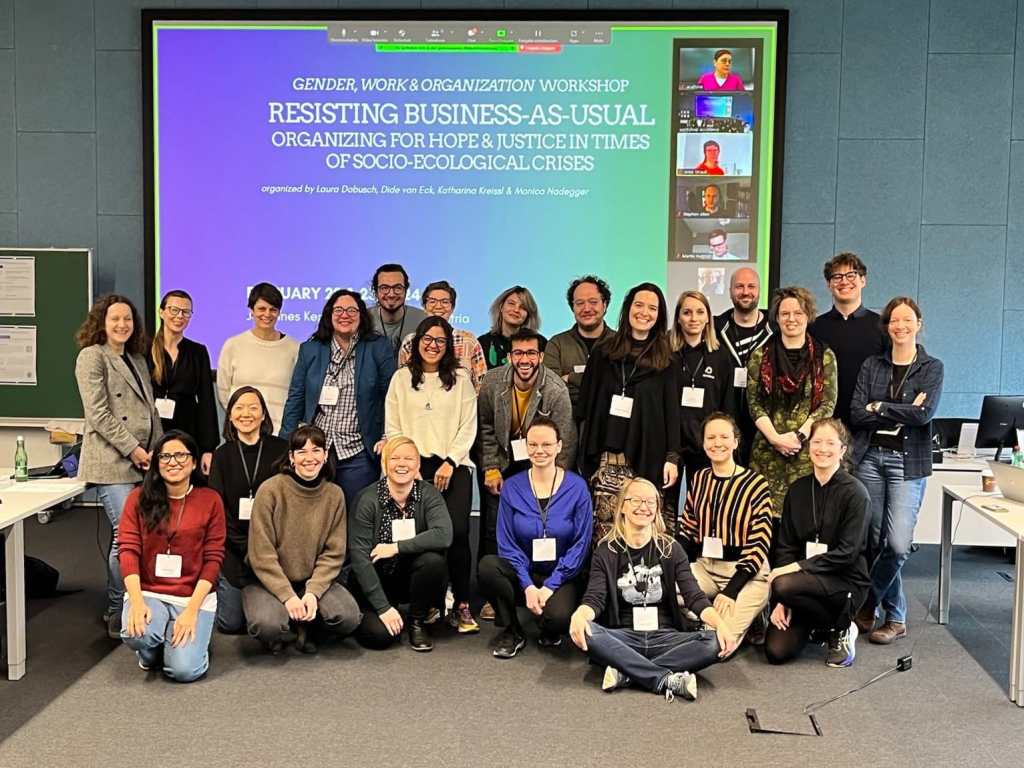
On Feb 23 & 24, we were happy to welcome participants to our GWO* workshop “Resising Business-As-Usual,” both online and on-site at the JKU Linz to our workshop. Inspired by the conversations and the burning dilemmas on the nexus between social justice and the climate crisis, we want to share a short recap on the workshop, the formats we experimented with, and a recording of the panel discussion with you here.

Continue reading “Recap of the Workshop “Resisting Business-As-Usual” – Feb 23-24, JKU Linz”

Join our panel discussion at the GWO Workshop “Resisting Business-As-Usual”!

From February 22-23, we – Laura Dobusch (JKU Linz), Dide Van Eck (Utrecht School of Governance), Katharina Kreissl (JKU Linz), and I – are excited to host a hybrid workshop on “Resisting Business-As-Usual” at the JKU Linz, sponsored by Gender, Work & Organization. While the workshop promises vibrant discussions on burning dilemmas at the nexus between social justice and the climate crisis for accepted participants, you still have the opportunity to listen to our fantastic panel. Curious? Find more information here!

Continue reading “Join our panel discussion at the GWO Workshop “Resisting Business-As-Usual”!”

Join our inspiring February: upcoming keynote and mini-workshop!

On February, 19-20, organization scholars from Innsbruck will host a small workshop titled “Communication as a Practice – Bridging Communication and Practice Perspectives in Organization Studies”. In the context of this workshop, our three international guests offer a great program open to everyone interested! Come and join us for a fantastic keynote and an insightful workshop session!

Continue reading “Join our inspiring February: upcoming keynote and mini-workshop!”

Five points I tell my students about citing and using Wikipedia

Foto: veryinformed.com at unsplash.com

While most academics and journalists, just like everybody else, heavily relies on Wikipedia for both private and professional purposes, it is quite common in among both these groups to scold anyone who openly admits doing so. For example, many lecturers tend to make fun of students citing Wikipedia and pride themselves in educating them that “Wikipedia is not a source” and, thus, cannot be cited in a seminar paper.

I not only strongly disagree with both tone and substance of such statements, but I regularly have to deal with insecurity and uncertainty among students with respect to the proper use of Wikipedia. The following list presents the five main points I try to bring across in such situations.

Continue reading “Five points I tell my students about citing and using Wikipedia”

Festrede zu “Reform und Zukunft des öffentlich-rechtlichen Rundfunks” beim Otto-Brenner-Preis 2023

In der Festrede anlässlich der Verleihung der Otto-Brenner-Preise für kritischen Journalismus 2023 habe ich in der laufenden Debatte eine provokant-optimistische These vertreten: Die besten Zeiten öffentlich-rechtlicher Medien liegen noch vor uns.

Das Manuskript meiner Rede ist in voller Länge bei Netzpolitik.org in der Reihe “Neues aus dem Fernsehrat” erschienen.

Medieninterviews und Erklärstück zur Krise von René Benkos Signa-Gruppe [Updates]

Wird Signas Elbtower in Hamburg fertig gebaut werden? (Foto: Uwe Rohwedder, CC BY-SA 4.0)

Hauptgrund für mein Interesse am Geschäftsgebaren der in Innsbruck ansässigen Signa Holding sowie deren weitverzweigtem Geflecht an Unternehmensbeteiligungen ist meine Forschung zu finanzialisierten Geschäftsmodellen im Immobiliensektor. Anlässlich der jüngsten wirtschaftlichen Turbulenzen der Signa-Gruppe, habe ich im Moment Magazin versucht, einige häufige Fragen zum Fall so einfach wie möglich zu beantworten:

  • Warum ist René Benkos Signa-Gruppe in wirtschaftlichen Schwierigkeiten?
  • Warum steckt sie offenbar in größeren Schwierigkeiten als andere Immobilienunternehmen?
  • Warum fällt es Signa so schwer, neue Kapitalgeber zu finden?
  • Wer zahlt eigentlich am Ende drauf, sollte Signa Pleite gehen?

Außerdem habe ich mich in einer Reihe von Medieninterviews bemüht, die Hintergründe zu erklären und Einschätzungen zur weiteren Entwicklung abgegeben:

Continue reading “Medieninterviews und Erklärstück zur Krise von René Benkos Signa-Gruppe [Updates]”

New Article in The Conversation: “Why young workers are leaving fossil fuel jobs – and what to do if you feel like ‘climate quitting’”

Credit: Documerica on Unsplash

Increasingly, we can observe employees leaving a job due to concerns about their employer’s impact on the climate or because you want to work directly on addressing climate issues. Together with Grace Augustine (University of Bath), I have published an article in The Conversation on this phenomenon, often referred to as “climate quitting”:

If you’re contemplating leaving your job over climate concerns, you’re not alone. Half of Gen Z employees (people born between the late 1990s and early 2010s) in the UK have already resigned from a job due to a conflict in values. And 48% of people aged 18–41 say they are willing to take a pay cut to work for a company that aligns with their sustainability values.

Check out the whole article “Why young workers are leaving fossil fuel jobs – and what to do if you feel like ‘climate quitting’” over at The Conversation.

“Capable of anything, culpable for nothing”: Last Week Tonight with John Oliver on McKinsey

Screenshot Last Week Tonight on McKinsey
Screenshot of Last Week Tonight segment on “McKinsey” (at about 25:36)

John Oliver’s Last Week Tonight with its well-researched and in-depth segments of journalism in satire’s clothing regularly manages to escape the 24-hour news cycle and instead set the agenda themselves. And if John Oliver takes on large consulting firms in general and McKinsey in particular, it is a must-watch for any student and scholar of management and organization studies. Check it out:

I would have enjoyed this piece very much, hadn’t it been all too accurate a depiction of systemic deficiencies in our contemporary corporate world. And while I really applaud the way the segment demonstrates that the problem with McKinsey is not one of “bad apples” but rather systemic, indeed, it does not really offer suggestions on how to improve the situation.

Continue reading ““Capable of anything, culpable for nothing”: Last Week Tonight with John Oliver on McKinsey”