Three Entries in the EE Encyclopedia of Strategy-as-Practice: »Organization«, »Practices« & »Participation«

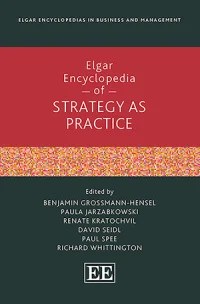
Cover of the Edward Elgar Encyclopedia of Strategy as Practice

Together with three (former) doctoral students of mine, I had the honor to contribute three quite foundational entries to the brand new Edward Elgar Encyclopedia of Strategy as Practice, edited by Benjamin Grossmann-Hensel, Paula Jarzabkowski, Renate Kratochvil, David Seidl, Paul Spee, and Richard Whittington.

»Organization« (with Alwin Baumhöver):

The ontological question of what defines an organization has not been a central theme in strategy-as-practice (SAP) research (Kuhn, 2021), similar to more traditional strategy research that mostly takes organization for granted, as well. Yet, given the flat ontology of practice-theoretical approaches in general, the (re-)constitution of organizational phenomena from an SAP perspective can be conceptualized in the same manner as any social formation, based upon ongoing, patterned, and socially situated human activities (Schatzki, 2006). Building upon these foundations, one could even go so far to posit that what makes a social formation organizational in particular, is that its constituting bundle of interrelated sociomaterial practices is, at least to some degree, coordinated or driven by practices labelled as ‘strategic’ or ‘strategy-making’.

Continue reading “Three Entries in the EE Encyclopedia of Strategy-as-Practice: »Organization«, »Practices« & »Participation«”

New Handbook Chapter: »Open Strategy as a New Form of Strategizing«

Together with Julia Hautz and Thomas Ortner (both situated at the neighboring department of Strategic Management and Leadership), I had the honor to contribute to the most recent iteration of the Cambridge Handbook of Strategy as Practice with a chapter on “Open Strategy as a New Form of Strategizing”:

[W]e can observe an increasing trend towards more inclusive and transparent strategizing. From a practice perspective, this trend can be described as a shift in the practices of strategy-making. [We] describe the different practices of inclusiveness and transparency and show how they relate to each other. [We] then identify and review distinctive themes of strategy as practice research on Open Strategy. This includes the role of technologies and materiality in enabling openness, the discursive practices and processes underpinning openness, the temporal dynamics of open processes, the difference between controlled and uncontrolled forms of openness and the dialectic relationship between openness and closure.

Check out the article here – and please contact me to receive a personal copy in case your institution does not provide access to the handbook.