
Antrittsvorlesung von Prof. Leonhard Dobusch: »Die Organisation der Digitalität: Zwischen grenzenloser Offenheit und offener Exklusion«

ldpic_credit_dominik_landwehr_smallAm Dienstag, 24. Jänner 2017, 17:00 Uhr, findet im Kaiser-Leopold-Saal der Katholisch-Theologischen Fakultät Karl-Rahner-Platz 3, A-6020 Innsbruck die Antrittsvorlesung von Leonhard Dobusch zum Thema “Die Organisation der Digitalität: Zwischen grenzenloser Offenheit und offener Exklusion” statt.
Antrittsvorlesungen richten sich an ein breites Publikum und wir würden uns freuen, bekannte Gesichter aus der Organization Studies Innsbruck Community dort zu sehen.

Details und eine ausführliche Biographie von Leonhard Dobusch finden sich im Flyer zur Veranstaltung. Um Anmeldung wird bis spätestens Freitag, 20. Jänner 2017, an veranstaltung-bw@uibk.ac.at gebeten.

New Publication: »Making an Impression with Openness: How Open Strategy-Making Practices Change in the Evolution of New Ventures«

gegenhuber-dobusch2016figure3

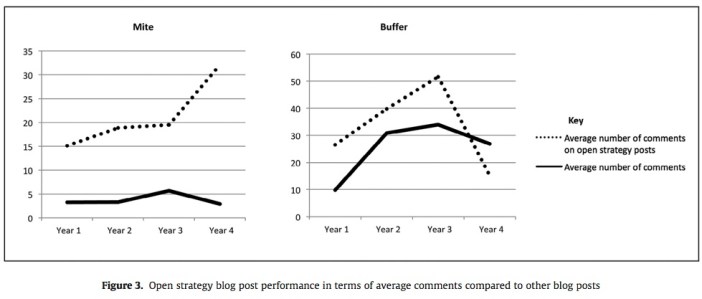
Thomas Gegenhuber and I have tracked open strategy-making practices on blogs of two ventures (Berlin-based mite and buffer in San Francisco) over the period of four years to answer the research question “how new ventures use open strategy-making as impression management over time?”. The article entitled “Making an Impression Through Openness: How Open Strategy-Making Practices Change in the Evolution of New Ventures” has now been accepted for publication in Long Range Planning as part of a special issue on Open Strategy (edited by Julia Hautz, David Seidl and Richard Whittington). The abstract reads as follows:

While previous open strategy studies have acknowledged open strategy’s function as an impression management instrument, their focus has mostly been on short episodes. The impression management literature, meanwhile, pays openness scant attention. By studying how new ventures engage in open strategy-making, we track how open strategy-making and respective impression management benefits evolve over time. Specifically, we draw on a comparative case study of two firms’ blog communication on strategy-related issues and corresponding audience responses over a four-year period. We identify three distinct modes of how organizations engage in open strategy-making with external audiences and show how each mode is related to a specific set of impression management effects. Having established the impression management functions of these modes, we then demonstrate how open strategy-making contributes to new ventures’ quests for legitimacy as they evolve. In the launch phase, dialoguing with blog audiences helps a venture attract endorsements for its organization and products. As the venture grows, concentrating on broadcasting relevant strategic information may attract media audiences’ additional support for pursuing openness as a desirable organizational practice.

Thomas has also blogged about our study. If your institution does not provide access to the article just e-mail me and I would be happy to share it with you. For more on open strategy-making in general and other contributions to the special issue in Long Range Planning, join the recently launched Open Strategy Network.

EGOS Sub-theme Call for Papers: »Open Strategy: Practices, Perspectives and Problems«

screenshot-egos-copenhagen

The 33rd EGOS Colloquium will take place from July 6–8, 2017 in Copenhagen, Denmark, and together with Georg von Krogh (ETH Zürich) and Richard Whittington (Oxford University) I will be convenor of sub-theme 50 on “Open Strategy: Practices, Perspectives and Problems“. Please find the Call for Short Papers below, submission deadline is January 9, 2017:

Many organizations in public, private and non-for-profit sectors are becoming more transparent about their strategies, while also including a wider range of actors in strategy development. These moves involve a variety of strategy practices, for example strategy jamming (Bjelland & Wood, 2008), strategy crowdsourcing (Stieger et al., 2012), strategy blogs and wikis (Dobusch & Kapeller, 2013) or strategy simulations in online games (Aten & Thomas, 2016). Although involving many different practices, this phenomenon has been described most comprehensively as ‘open strategy’ (Chesbrough & Appleyard, 2007; Whittington et al., 2011).

Building upon these studies, recent works on open strategy have begun to look at open strategy from an increasing variety of perspectives such as impression management (Whittington et al., 2016), middle-management inclusion in strategy-making (Wolf et al., 2014) or the inter-organizational explorations of strategic issues (Werle & Seidl, 2015). However, systematic cross-fertilization between the emerging open strategy literature and other areas and concepts of organizational openness are still rare. Continue reading “EGOS Sub-theme Call for Papers: »Open Strategy: Practices, Perspectives and Problems«”