The Excluding Effects of Boundaries in the Case of English Wikipedia

(Picture taken from this blog post on “Diversity in Wikipedia”)

This research essay is authored by Eva-Maria Schillinger, student in the master course Open Organizations and Organizing Openness at University of Innsbruck.

As a worldwide, open and collaborative knowledge sharing platform, Wikipedia has largely replaced the need for physical encyclopedias for many. From children using it for their first school presentations to university professors and academics, the readership is broad and diverse. And since Wikipedia prides itself on being an open-for-anyone space for collaboration, you would think that the large community of editors and contributors should be similar in diversity, but this is not the case. While there are multiple dimensions of diversity that could be examined in the case of Wikipedia, gender is the most visible and prominent facet. But not only diversity among users is more scarce than expected, furthermore there is a lack of inclusivity of perspectives and alternative opinions, which in some cases can lead to misrepresentation. Recognizing the lack of diversity among editors and the resulting bias in the content displayed is crucial for making attempts to increase inclusivity in both areas, which according to Wikipedia’s principle of equality should be the goal of the organization and its vast community. Finding the causes for this exclusion is the next step. This essay will examine potential exclusionary effects of boundaries around and within Wikipedia and how they inhibit inclusivity for both contributors and content. In total, four boundaries and their potential for exclusion are discussed. The focus lies on the English version of Wikipedia to keep an appropriate scope.

Continue reading “The Excluding Effects of Boundaries in the Case of English Wikipedia”

Inspiring input, exhausting heat, and dolce vita! A short summary of the 39th EGOS Colloquium 2023 in Cagliari

Last week, Monica Nadegger, Katharina Zangerle, and Milena Leybold (University of Innsbruck, Department for Organization and Learning) traveled to the beautiful island Sardegna to meet for four days with around 2000 people at the Colloquium of the European Group of Organization Studies. 

From the left: Monica Nadegger, Milena Leybold, Katharina Zangerle
Continue reading “Inspiring input, exhausting heat, and dolce vita! A short summary of the 39th EGOS Colloquium 2023 in Cagliari”

Discussion Proposal: Increasing Vaccine Access in a Shorter Time

As we have all experienced recently, to prevent pandemic outbreaks or mitigate an evolving pandemic crisis, it is of utmost importance to guarantee timely and global access to safe and effective vaccines. Through their pre-print, Milena Leybold (University of Innsbruck) and Konstantin Hondros (University of Duisburg-Essen) make a step towards opening a debate on “Increasing Vaccine Access in a Shorter Time. Alternative Regulatory Frameworks in Response to Pandemics.” 

Source: Agência Brasília, https://www.flickr.com/photos/64586261@N02/51330020291/
Continue reading “Discussion Proposal: Increasing Vaccine Access in a Shorter Time”

New Article in Organization Theory: »Taking Individual Choices Seriously: A process perspective of self-selection in strategy work«

I am very glad to announce that the article “Taking Individual Choices Seriously: A process perspective of self-selection in strategy work”, co-authored by Martin Friesl, Martin Brielmaier and myself, has been accepted for publication at Organization Theory and is already available online. Particularly the growing interest in open approaches to strategy, which at least formally invite broad audiences to participate in organizational strategy-making, was one of the reasons for writing this paper. Not just because an invitation to participate cannot hardly intrinsic motivation to actually contribute but also because inviting everyone does not guarantee that you will actually arrive at a more diverse and inclusive bunch of people (see also Dobusch et al., 2019). The abstract reads as follows:

An increasing body of work investigates the participation of a diverse set of actors in strategy making. We argue that extant research tends to gloss over a fundamental condition underpinning such participation: while participation may reflect a hierarchical mandate, insofar as it relates to the actual involvement of employees, it is the result of a process of self-selection. From this perspective, forms of participative strategizing are neither fully the outcome of deliberate top-down choice, nor do they form a random pattern that is subject to the whims of individual employees. Such forms of strategizing are rather, as we argue in this paper, based on an endogenous logic of whether and how an individual self-selects, and in turn involves her/himself in the process, or not. To conceptualize the broader phenomenon of strategy participation, we draw on practice theory to conceptualize how individuals knowingly choose to involve themselves in strategizing events and we develop in turn a process model of self-selection as an ongoing social accomplishment. This model elaborates different patterns of participation in strategy making (stabilizing and shifting trajectories) with variable emergent outcomes. We end the paper by discussing the implications of our theorizing for ongoing research on open and participatory strategizing, and for the body of work on strategy as practice.

The paper is open access available at Organization Theory. Summary threads ft. #1paper1meme can be found over at Mastodon and Twitter.

Re:publica 2023: Rundfunkbeitragsdebatte und Predictive Risk Analysis entlang von Lieferketten

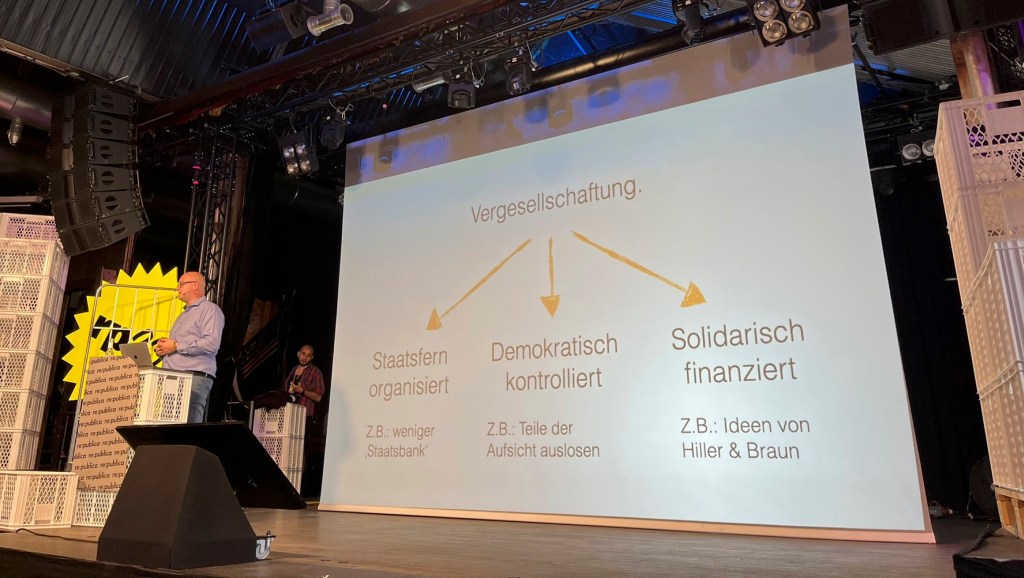
Die jährlich in Berlin stattfindende re:publica ist wahrscheinlich eine der spannendsten und inklusivsten Digitalkonferenzen und für mich jedes Jahr ein Highlight in meinem Konferenzkalender. Dieses Jahr war ich mit einem Vortrag und als Teil eines Panels im Programm vertreten.

In meinem Vortrag habe ich versucht, den Bogen von der – auch in Österreich im Zuge der Einführung einer Haushaltsabgabe gerade aktuellen – Rundfunkbeitragsdebatte hin zur Vergesellschaftungsdebatte zu spannen, indem ich öffentlich-rechtliche Medien als wichtiges Beispiel für vergesellschaftete Organisationsformen unserer Zeit in den Blick genommen habe (Slides als PDF-Download).

Außerdem war ich gemeinsam mit Sabrina Zajak, Akhil C S und Lisa Basten Teil eines Panels zum Thema “Global Supply Chains – Digital Tools Between Empowerment And Control” und habe dort vor allem über den problematischen Einsatz von Predictive Risk Analysis-Tools zur Überwachung und Steuerung von globalen Lieferketten gesprochen – das Thema eines von der Hans-Böckler-Stiftung geförderten Forschungsprojekts.

Neuer Buchbeitrag: »’Schöne neue Lieferkettenwelt’: Workers’ Voice und Arbeitsstandards in Zeiten algorithmischer Vorhersage«

Im Rahmen eines von der Hans-Böckler-Stiftung geförderten Forschungsprojekts zum Verhältnis von ‘Predictive Risk Intelligence’ und Interessenvertretung in Lieferketten ist jetzt ein von Lukas Daniel Klausner, Maximilian Heimstädt und mir verfasster Buchbeitrag mit dem Titel “‘Schöne neue Lieferkettenwelt’: Workers’ Voice und Arbeitsstandards in Zeiten algorithmischer Vorhersage” (PDF) erschienen:

Die Komplexität und zunehmend enge Kopplung vieler Lieferketten stellt eine große logistische Herausforderung für Leitunternehmen dar. Eine weitere Herausforderung besteht darin, dass Leitunternehmen — gedrängt durch Konsument:innen, eine kritische Öffentlichkeit und gesetzgeberische Maßnahmen wie die Lieferkettengesetze — stärker als bisher Verantwortung für Arbeitsstandards in ihren Zulieferbetrieben übernehmen müssen. In diesem Beitrag diskutieren wir einen neuen Ansatz, mit dem Leitunternehmen versuchen, diese Herausforderungen zu bearbeiten: die algorithmische Vorhersage von betriebswirtschaftlichen, aber auch ökologischen und sozialen Risiken. Wir beschreiben die technischen und kulturellen Bedingungen für algorithmische Vorhersage und erklären, wie diese — aus Perspektive von Leitunternehmen — bei der Bearbeitung beider Herausforderungen hilft. Anschließend entwickeln wir Szenarien, wie und mit welchen sozialen Konsequenzen algorithmische Vorhersage durch Leitunternehmen eingesetzt werden kann. Aus den Szenarien leiten wir Handlungsoptionen für verschiedene Stakeholder-Gruppen ab, die dabei helfen sollen, algorithmische Vorhersage im Sinne einer Verbesserung von Arbeitsstandards und Workers’ Voice weiterzuentwickeln.

Der Beitrag ist Teil eines von Thomas Haipeter und anderen herausgegebenen Sammelbands “Soziale Standards in globalen Lieferketten: Internationale Richtlinien, unternehmerische Verantwortung und die Stimme der Beschäftigten”, der bei Transcript als Open-Access-Volltext verfügbar ist.

Beiträge im Sammelband “Geben, Nehmen, Teilen: Gabenwirtschaft im Horizont der Digitalisierung”

“Open source, file-sharing, crowdfunding, liking – die Welt der digitalen Kommunikation ist voller Wirtschaftspraktiken, die dem Geben, Nehmen und Teilen näher sind als dem Verkaufen, Kaufen und Leihen.”

Mit diesem Satz beginnen Michael Hutter und Birger P. Priddat die Einleitung des von ihnen herausgegebenen Sammelbands “Geben, Nehmen, Teilen: Gabenwirtschaft im Horizont der Digitalisierung,” der im Anschluss an zwei Tagungen zum Thema im April 2021 und März 2022 erschienen ist und unter anderem Beiträge von Jasmin Schreyer oder Günther Ortmann enthält.

Continue reading “Beiträge im Sammelband “Geben, Nehmen, Teilen: Gabenwirtschaft im Horizont der Digitalisierung””

Coffee – PuB – Peers and Beverages: Academic Writing as an Early Career Scholar

Join us for an open conversation on academic writing, its beauty and challenges, and the pressure of “you should be writing” as early career scholars over a coffee on March 14th!

Academic writing can be a fulfilling but also challenging and overwhelming experience for early career scholars. On March 14th from 13.00 to 14.30, please join us for an honest exchange on our struggles and great moments in writing. Daniela Rothe (Writing Center, University of Innsbruck) will talk about the practice of journalling in academia, the tinkering between the scientific object itself and writing, and the re-(production) of gender stereotypes in scientific writing. Monica, Milena, and Ellen (early career researchers at the University of Innsbruck & Leuphana University Lüneburg) will share their writing experiences based on a collective letter diary they wrote to each other over a couple of months to reflect on their writing practices.

We would love to hear about your experiences, too, and together question and discuss the norms and ways of academic writing.

Key Information

  • When? Tuesday, March 14, 2023 –  1 – 2.30 pm
  • Where?  Marketing Spitz (SOWI, 3rd floor, East)

You can find further information about the event here.

Title image: Victor Freits via Pexels

Präsentation der Auftragsstudie “Innsbruck Aktiv gegen Teuerung”

Gemeinsam mit Innsbrucks Bürgermeister Georg Willi bei der Präsentation der Studie

Im Auftrag der Stadt Innsbruck habe ich gemeinsam mit meiner Mitarbeiterin Daria Schaller im Rahmen einer Machbarkeitsstudie untersucht, wie und in welchem Umfang es auch in Innsbruck möglich wäre, einen institutionellen Anker für Unterstützungsleistungen und Ermäßigungen für finanziell schwächere Bürger:innen bzw. Haushalte zu etablieren.

Die Einführung einer Innsbruck Aktiv Card nach Vorbild des Linzer Aktivpasses oder der Grazer Sozialcard würde es ermöglichen, zielgerichtet Menschen zu entlasten, die von der Teuerung besonders betroffen sind und gleichzeitig eine Möglichkeit für nachhaltige Angebote zur Stärkung gesellschaftlicher Teilhabe armutsgefährdeter Personengruppen jenseits von Mindestsicherungsbezieher:innen zu schaffen.

Die Studie ist im Volltext und unter freier Lizenz als PDF online zugänglich.

Weitere Berichte über die Studienpräsentation: