New Publication: »Open strategy-making with crowds and communities«

Academic publication processes often take some time. For example, the article “Open strategy-making with crowds and communities: Comparing Wikimedia and Creative Commons” by Jakob Kapeller and myself, which has now been published in Long Range Planning, is not entirely new. Back in 2013 at the Academy of Management Annual Meeting in Orlando, Florida, we had already received the prestigious Carolyn Dexter Best International Paper Award for a previous version of the article. Several rounds of revision later, we can proudly present the abstract of the now published final version of the paper:

In the wake of new digital technologies, organizations rely increasingly on contributions by external actors to innovate or even to fulfill their core tasks, including strategy-making processes. These external actors may take the form of crowds, where actors are isolated and dispersed, or of communities, where these actors are related and self-identify as members of their communities. While we know that including new actors in strategy-making may lead to tensions, we know little about how these tensions differ when either crowds or communities are concerned. Investigating this question by analyzing open strategy-making initiatives conducted by two non-profit organizations (Creative Commons and Wikimedia), we find that tensions with communities may be resolved with increasing openness in strategy-making, while crowds are better compatible with more exclusive strategy-making practices.

The full text of the article is available at the journal’s website. As usual, please send me an e-mail in case you are interested but your institution does not provide access to the journal.

New Publication: »Open to Feedback? Formal and Informal Recursivity in Creative Commons’ Transnational Standard-Setting«

SOTC-gif-main
Animation by Creative Commons (Source)

Together with Sigrid Quack (University of Duisburg-Essen) and Markus Lang (University of Heidelberg), I have investigated the case of Creative Commons to learn more about formal and informal feedback cycles in transnatioal standard-setting. The article “Open to Feedback? Formal and Informal Recursivity in Creative Commons’ Transnational Standard-Setting” has been published in Global Policy and the abstract reads as follows:

In this article, we examine how non-membership organizations that claim stewardship over a transnational public or common good, such as the environmental or digital commons, develop combinations of formal and informal recursivity to develop and maintain regulatory conversations with their dispersed user communities. Based on a case study of Creative Commons, an organization that developed what have become the most widely used open licenses for digital content, we show how rhetorical openness to informal feedback from legitimacy communities in different sectors and countries can improve the feasibility and diffusion of standards. However, as long as the standard-setter’s methods of making decisions on the basis of such feedback remains opaque, its communities are likely to raise accountability demands for more extensive ex post justifications.

Global Policy also asks its authors to provide at least three policy implications, which we were happy to deliver: Continue reading “New Publication: »Open to Feedback? Formal and Informal Recursivity in Creative Commons’ Transnational Standard-Setting«” →

New Publication: »A Communication Perspective on Open Strategy and Open Innovation«

In a recent article (PDF) published in the leading German management research journal Managementforschung, Waldemar Kremser (Radboud University Nijmegen), David Seidl, Felix Werle (both University of Zurich) and I have tried to systematically compare the more recent stream of literature on open strategy-making with previous studies on open innovation. For doing so, we operationalized organizational openness in communication terms, guided by a Luhmannian understanding of organizations as communication. The abstract of the paper reads as follows: Continue reading “New Publication: »A Communication Perspective on Open Strategy and Open Innovation«” →

New Publication: »Financialization as Strategy« in Accounting, Organizations and Society

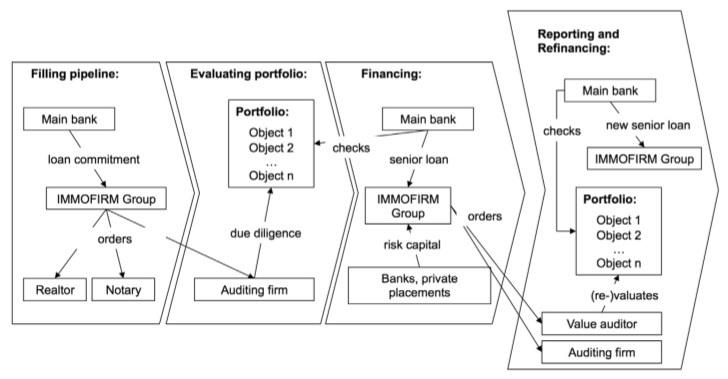
Business process and inter-organizational relations of the IMMOFIRM Group.

The paper “Financialization as strategy: Accounting for inter-organizational value creation in the European real estate industry”, co-authored with Sebastian Botzem and published in Accounting, Organizations and Society, investigates an in-depth case study of a European real estate firm and its financialized business model. The key findings of our study can be summarized as follows (German version): Continue reading “New Publication: »Financialization as Strategy« in Accounting, Organizations and Society” →

New Publication: »Openwashing: A Decoupling Perspective on Organizational Transparency«

Bildschirmfoto 2017-04-02 um 22.47.22

In my PhD project (supervised by Leonhard Dobusch) I studied the institutionalization of Open Data in and around the city administrations of Berlin, London and New York City.  One of the questions I tried to answer was how organizations balance a public demand for information sharing with their inherent preference for informational control. My answers have now been published in an article entitled “Openwashing: A decoupling perspective on organizational transparency” in Technological Forecasting and Social Change as part of a Special Issue on the Sharing Economy (edited by Aurélien Acquier, Thibault Daudigeos and Jonatan Pinkse). The abstract reads as follows: Continue reading “New Publication: »Openwashing: A Decoupling Perspective on Organizational Transparency«” →

‘Forum Wissenschaft’: »Erst Offenheit gibt digitaler Bildung Richtung«

cover-forum-wissenschaftGemeinsam mit Maximilian Heimstädt durfte ich noch im alten Jahr einen Beitrag für die aktuelle Ausgabe von “Forum Wissenschaft”, der Zeitschrift des Bunds demokratischer Wissenschaftlerinnen und Wissenschaftler (BdWi) zum Thema digitale Bildung beisteuern. Der Lead-Text stammt zwar nicht von uns, trifft aber ziemlich gut, worum es uns in dem Beitrag geht:

Digitalisierung im Bildungsbereich gehört zu den meistdiskutierten Fragen, wenn es um Modernisierungen im Bildungswesen geht. Im Fokus der öffentlichen Debatte steht dabei vor allem eine umfassende Verbesserung der technologischen Ausstattung von Schulen. Doch der alleinige Blick auf den technischen Fortschritt ist unzureichend. Vielmehr kommt es auf offenen Zugang und freie Verfügbarkeit an, wie Leonhard Dobusch und Maximilian Heimstädt erläutern.

Leider ist Forum Wissenschaft selbst nicht offen zugänglich bzw. (noch) keine Open-Access-Zeitschrift. Mit Zustimmung der Redaktion – und dem Thema entsprechend – dürfen wir den Beitrag hier als PDF im Volltext unter der Lizenz Creative Commons Namensnennung (CC-BY) zugänglich machen.

New Publication: »Whistleblowing, Parrhesia and the Contestation of Truth in the Workplace«

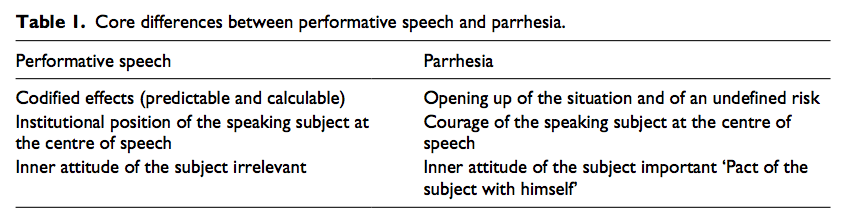
parrhesia-table

The article by Yvonne Tobias-Miersch and myself on whistleblowing as a critical practice has been accepted for publication in Organization Studies and is now available online. Check out the abstract here:

In this paper, we develop an approach to the study of whistleblowing as a critical practice that is involved in the contestation of truth and power in the workplace. We situate our analysis in the context of practice-based thinking and specify the social practice of whistleblowing with reference to Michel Foucault’s concept of ‘parrhesia’ (frank speech). We then introduce the case of Guido Strack, a former European Union official who worked as section leader at the Office des Publications Officielles des Communautés Européenne from 1995 to 2002. Strack spoke out against malpractice in the EU in 2001 and officially reported alleged financial misconduct in 2002. In our analysis, we focus on the interplay between and effects of different modes of truth-telling in the context of this specific organization – a context marked by the uneasy coexistence of different normative and discursive frames. We argue that the parrhesiastic modality of truth-telling threatens the established ‘working solutions’ that reconcile the tensions inherent in the regime of practices and thus introduces a ‘critical opening’ that harbours the potential for both personal and organizational transformation. We conclude by highlighting the potential of a nuanced understanding of parrhesia for studying ‘critical practices’ more generally.

In case you or your institution does not have access to the publication, I would be happy to provide you a copy of the article via e-mail.

New Publication: »Making an Impression with Openness: How Open Strategy-Making Practices Change in the Evolution of New Ventures«

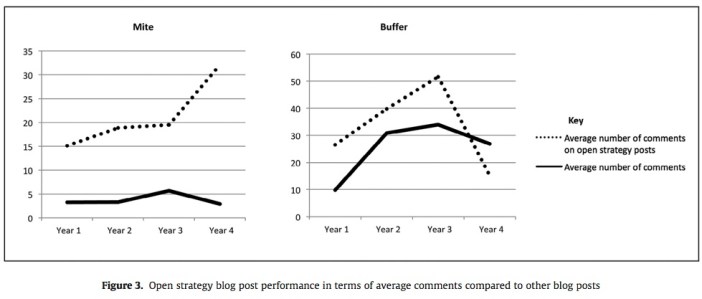
gegenhuber-dobusch2016figure3

Thomas Gegenhuber and I have tracked open strategy-making practices on blogs of two ventures (Berlin-based mite and buffer in San Francisco) over the period of four years to answer the research question “how new ventures use open strategy-making as impression management over time?”. The article entitled “Making an Impression Through Openness: How Open Strategy-Making Practices Change in the Evolution of New Ventures” has now been accepted for publication in Long Range Planning as part of a special issue on Open Strategy (edited by Julia Hautz, David Seidl and Richard Whittington). The abstract reads as follows:

While previous open strategy studies have acknowledged open strategy’s function as an impression management instrument, their focus has mostly been on short episodes. The impression management literature, meanwhile, pays openness scant attention. By studying how new ventures engage in open strategy-making, we track how open strategy-making and respective impression management benefits evolve over time. Specifically, we draw on a comparative case study of two firms’ blog communication on strategy-related issues and corresponding audience responses over a four-year period. We identify three distinct modes of how organizations engage in open strategy-making with external audiences and show how each mode is related to a specific set of impression management effects. Having established the impression management functions of these modes, we then demonstrate how open strategy-making contributes to new ventures’ quests for legitimacy as they evolve. In the launch phase, dialoguing with blog audiences helps a venture attract endorsements for its organization and products. As the venture grows, concentrating on broadcasting relevant strategic information may attract media audiences’ additional support for pursuing openness as a desirable organizational practice.

Thomas has also blogged about our study. If your institution does not provide access to the article just e-mail me and I would be happy to share it with you. For more on open strategy-making in general and other contributions to the special issue in Long Range Planning, join the recently launched Open Strategy Network.