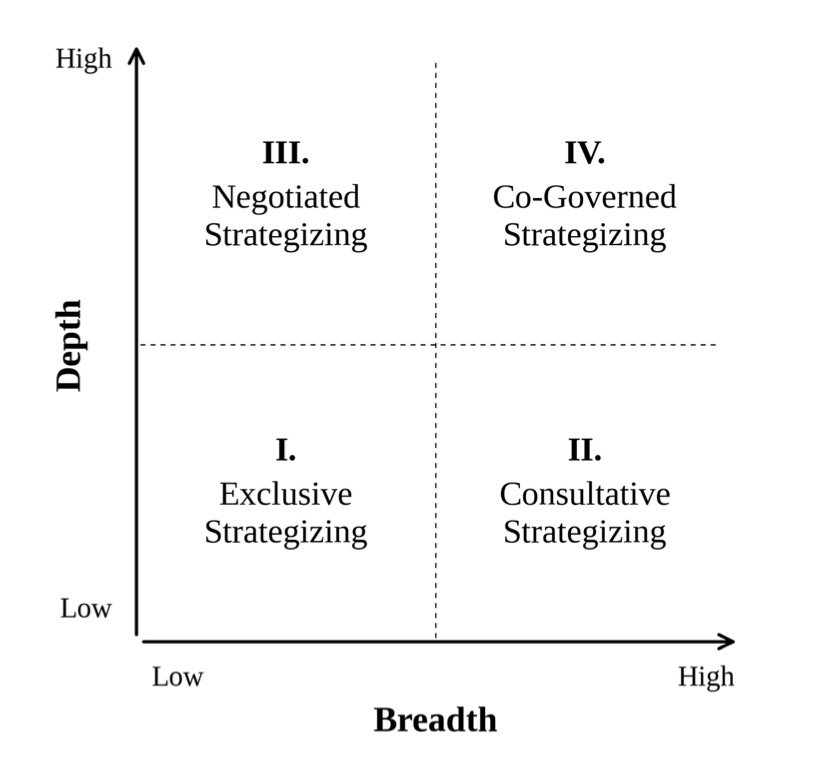
The breadth-depth matrix of inclusion in strategy-making (Schmid & Dobusch, 2026)
Looking back, I can hardly remember a research project where the research gap was so glaringly obvious to me: while open strategy research investigates transparent and participatory approaches to strategy-making, over more than a decade of Open Strategy research not a single article addressed its relationship to traditional forms of workplace democracy. This is particularly stunning since increasing transparency and participation in strategy are key tasks of works councils and codetermination regulations in many continental European countries.
Yet, there are several reasons for this omission:
- There is an inherent top management bias in strategy research as top management is defined as the acting subject in traditional strategy theory
- Another bias in strategy research is an overwhelming focus on the Anglo-Saxon realm, while traditional workplace democracy as a topic is predominantly pertinent in continental Europe and frequently published in languages other than English
- In addition, open strategy research reflects that most empirical cases of strategy-making labelled as ‘open’ are mostly management-led and temporary initiatives.
Give this situation, it was by no means certain that the research essay by Felix Schmid and myself on “Open Strategy and Traditional Workplace Democracy: Bridging Breadth and Depth of Inclusion” was to be easily published. Consequently, I am all the more pleased to report that it has just been accepted for publication at Strategic Organization. The abstract reads as follows:
Open Strategy (OS) aims to make strategy making more inclusive. Yet its focus on breadth (engaging many voices) often neglects depth (ensuring those voices count), risking tokenism that undermines durability. To address this deficit, we juxtapose the broad-but-shallow approach of OS with the deep-but-narrow practices of Traditional Workplace Democracy (TWD). From this, we develop a two by two framework that reveals four archetypes of inclusion in strategy making. The framework positions most OS practices as Consultative Strategizing (high breadth, low depth) and TWD as Negotiated Strategizing (low breadth, high depth). To overcome its depth deficit, we propose mechanisms that embed depth in OS without sacrificing breadth, such as the formalization of roles and the delegation of decision rights. Such a synthesis allows moving toward more effective and resilient forms of inclusion, including Co-Governed Strategizing (high breadth, high depth), thereby ensuring that inclusion in strategy making is both meaningful and durable.
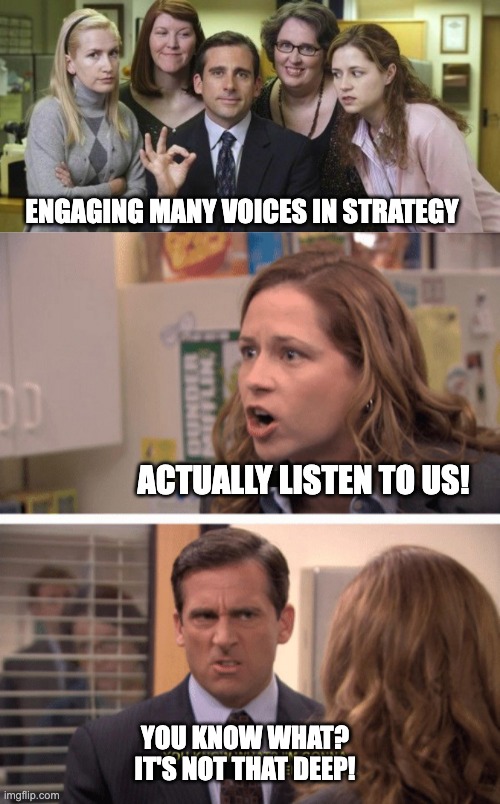
The article will soon be available open access over at Strategic Organization. In case you or your institution does not have access I would be happy to provide a personal copy. Finally, check out the obligatory #1paper1meme below: