Digital Democracy Day 2025: Interview und Impuls

Screenshot Online-Impuls im Rahmen des Digital Democracy Day 2025

Am 6. November 2025 fand in Berlin zum ersten Mal der #DigitalDemocracyDay2025 statt. Ich durfte mit einem kurzen Online-Impuls zum Thema “Von Wikipedia für Digitale Demokratie lernen” mit dabei sein (Slides). Bereits vorab hat Bernhard Seiler für SWR Aktuell Radio mit mir zum Thema gesprochen – das Interview findet sich hier zum Nachhören:

Die Aufzeichnung des Livestreams der Veranstaltung ist bereits online, mein Beitrag beginnt ungefähr bei 1h40 Minuten:

Im Folgenden meine Vortragsnotizen für all jene, die lieber lesen als schauen:

Continue reading “Digital Democracy Day 2025: Interview und Impuls”

Opening Keynote on ‘Science (Communication) and Wikipedia: Potentials and Pitfalls’

Recently I had the honor of providing the opening keynote to the conference “Enhancing the voice of science on Wikipedia: How universities can collaborate with the online encyclopedia in science communication”, taking place from April 9–11, 2024, at University of Innsbruck.

I seized the opportunity to reflect on the following questions:

  • How ‘scientific’ is Wikipedia?
  • How important is science for Wikipedia?
  • How important is Wikipedia for science?
  • How important is Wikipedia for our common knowledge?
  • What are potentials when science communication meets Wikipedia?
  • What are the pitfalls?
  • Is it worth it?

Please check out the video recording above and the slides below.

Five points I tell my students about citing and using Wikipedia

Foto: veryinformed.com at unsplash.com

While most academics and journalists, just like everybody else, heavily relies on Wikipedia for both private and professional purposes, it is quite common in among both these groups to scold anyone who openly admits doing so. For example, many lecturers tend to make fun of students citing Wikipedia and pride themselves in educating them that “Wikipedia is not a source” and, thus, cannot be cited in a seminar paper.

I not only strongly disagree with both tone and substance of such statements, but I regularly have to deal with insecurity and uncertainty among students with respect to the proper use of Wikipedia. The following list presents the five main points I try to bring across in such situations.

Continue reading “Five points I tell my students about citing and using Wikipedia”

The Excluding Effects of Boundaries in the Case of English Wikipedia

(Picture taken from this blog post on “Diversity in Wikipedia”)

This research essay is authored by Eva-Maria Schillinger, student in the master course Open Organizations and Organizing Openness at University of Innsbruck.

As a worldwide, open and collaborative knowledge sharing platform, Wikipedia has largely replaced the need for physical encyclopedias for many. From children using it for their first school presentations to university professors and academics, the readership is broad and diverse. And since Wikipedia prides itself on being an open-for-anyone space for collaboration, you would think that the large community of editors and contributors should be similar in diversity, but this is not the case. While there are multiple dimensions of diversity that could be examined in the case of Wikipedia, gender is the most visible and prominent facet. But not only diversity among users is more scarce than expected, furthermore there is a lack of inclusivity of perspectives and alternative opinions, which in some cases can lead to misrepresentation. Recognizing the lack of diversity among editors and the resulting bias in the content displayed is crucial for making attempts to increase inclusivity in both areas, which according to Wikipedia’s principle of equality should be the goal of the organization and its vast community. Finding the causes for this exclusion is the next step. This essay will examine potential exclusionary effects of boundaries around and within Wikipedia and how they inhibit inclusivity for both contributors and content. In total, four boundaries and their potential for exclusion are discussed. The focus lies on the English version of Wikipedia to keep an appropriate scope.

Continue reading “The Excluding Effects of Boundaries in the Case of English Wikipedia”

Medienauftritte zu Wikipedias 20. Geburtstag: Podcasts bis ARD-Tagesthemen

Source: Screenshot 20.wikipedia.org

Am 15. Januar 2021 feierte mit der Wikipedia ein historischer Glücksfall einer gemeinnützigen, kostenlosen und werbefreien Wissenssammlung 20. Geburtstag. Da ich mich ungefähr seit 2006 wissenschaftlich (z.B. auch in meiner Antrittsvorlesung hier an der Uni Innsbruck) und bloggend mit der freien Online-Enzyklopädie beschäftige, haben mich aus diesem Anlass einige Medienanfragen erreicht. Im folgende eine kurze Zusammenschau.

Video des Podcast-Gesprächs mit Markus Beckedahl von netzpolitik.org

SWR2 Forum zum Thema »Ist Wikipedia noch zu trauen?«

Gemeinsam u.a. mit Kollegen Christian Stegbauer (Uni Frankfurt) durfte ich in der Reihe SWR2 Forum eine knappe Stunde lang zum Thema “Veraltet, manipulativ, fehlerhaft – Ist Wikipedia noch zu trauen?” (MP3-Download, ca. 40 MB) diskutieren. Die Teilnehmenden wurden dazu virtuell aus Frankfurt, Berlin und Mainz (wo ich zum Zeitpunkt der Aufzeichnung war), zusammengeschaltet. Aus der Ankündigung:

Seit Jahren gehört sie zu den zehn beliebtesten Websites der Deutschen. Jede und jeder nutzt sie, Schüler und Studenten kommen ohne sie nicht mehr aus, dabei lassen die meisten Einträge wissenschaftliche Standards vermissen, weil sie ehrenamtlich von Laien verfasst sind. […] Doch seit geraumer Zeit mehren sich Zweifel an den Inhalten des unbezahlten Mitmachlexikons: Immer häufiger sind Artikel veraltet. Die Zahl der Autoren hat sich binnen zehn Jahren halbiert. Was ist da los?

Zumindest die Frage im Titel, ob der Wikipedia “noch zu trauen” ist, hat mich dabei schmunzeln lassen. Denn das zeigt, wie sehr sich das Bild der freien Enzyklopädie gewandelt hat. In den ersten Jahren war die Frage nämlich, ob einem derartigen Freiwilligenprojekt überhaupt zu trauen ist. Meine Antwort ist denn auch, dass Wikipedia-Inhalte heute wie damals exemplarisch dafür sind, dass Wissen immer ausgehandelt, vorläufig und potentiell falsch sein kann, die Wikipedia diese Eigenschaften von Wissen aber sehr explizit und nachvollziehbar macht.

Wikipedia-Forschung in der Frankfurter Allgemeinen Sonntagszeitung

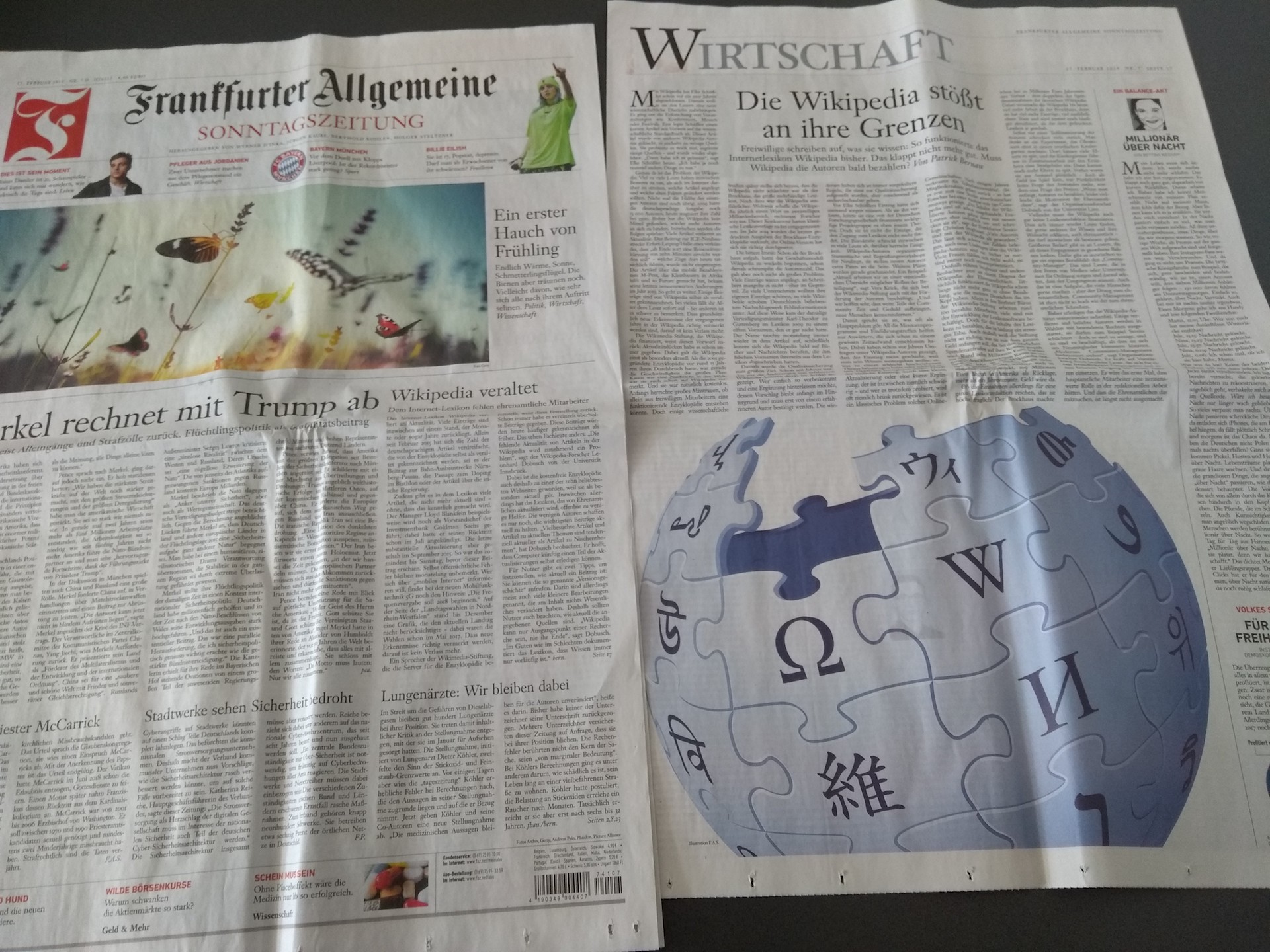
Artikel über Wikipedia am Cover und auf S. 17 der Frankfurter Allgemeinen Sonntagszeitung vom 17. Februar 2019

Das Thema sinkender oder stagnierender AutorInnenzahlen in der Wikipedia beschäftigt die gemeinnützige Wikimedia Foundation genauso wie die Wikipedia-Forschung: was sind die Ursachen für die seit zehn Jahren stagnierende Zahl an Beitragenden? Wie kann der trotzdem kontinuierlich wachsende Artikelbestand dennoch aktuell gehalten werden? Und welche Möglichkeiten gibt es, für mehr Diversität unter den Freiwilligen zu sorgen? Continue reading “Wikipedia-Forschung in der Frankfurter Allgemeinen Sonntagszeitung”

New Publication: »Open strategy-making with crowds and communities«

Academic publication processes often take some time. For example, the article “Open strategy-making with crowds and communities: Comparing Wikimedia and Creative Commons” by Jakob Kapeller and myself, which has now been published in Long Range Planning, is not entirely new. Back in 2013 at the Academy of Management Annual Meeting in Orlando, Florida, we had already received the prestigious Carolyn Dexter Best International Paper Award for a previous version of the article. Several rounds of revision later, we can proudly present the abstract of the now published final version of the paper:

In the wake of new digital technologies, organizations rely increasingly on contributions by external actors to innovate or even to fulfill their core tasks, including strategy-making processes. These external actors may take the form of crowds, where actors are isolated and dispersed, or of communities, where these actors are related and self-identify as members of their communities. While we know that including new actors in strategy-making may lead to tensions, we know little about how these tensions differ when either crowds or communities are concerned. Investigating this question by analyzing open strategy-making initiatives conducted by two non-profit organizations (Creative Commons and Wikimedia), we find that tensions with communities may be resolved with increasing openness in strategy-making, while crowds are better compatible with more exclusive strategy-making practices.

The full text of the article is available at the journal’s website. As usual, please send me an e-mail in case you are interested but your institution does not provide access to the journal.

Interview auf Deutschlandradio Kultur: »Wikipedia im Zeitalter von Fake News«

(Foto: Lane Hartwell, CC-BY-SA 3.0)

In der Sendung breitband auf Deutschlandradio Kultur ging es anlässlich des 16. Geburtstags der deutschsprachigen Wikipedia um die Frage, “[w]ie gut Wikipedia heute darin ist, die Qualität und die Unabhängigkeit seiner Inhalte zu sichern”.  Continue reading “Interview auf Deutschlandradio Kultur: »Wikipedia im Zeitalter von Fake News«”

»Zeit für Wissenschaft«: Leonhard Dobusch im Podcast der Universität Innsbruck

bild-zfw032
Zeit für Wissenschaft” ist der Titel der offiziellen Podcast-Reihe der Universität Innsbruck, in denen sich Melanie Bartos mit WissenschaftlerInnen ausführlich über ihre jeweilige Forschung unterhält. In der Ausgabe 32 der Podcast-Reihe war Leonhard Dobusch vom Institut für Organisation und Lernen das Gegenüber und sprach mit Melanie Bartos über Open Source, Creative Commons, Wikipedia und das Thema organisationale „Offenheit“ ganz allgemein.

Download des Podcasts als MP3

Erfreulicherweise – und passend zum Thema dieser Ausgabe – steht der Podcast unter einer Creative Commons Lizenz.