[W]e can observe an increasing trend towards more inclusive and transparent strategizing. From a practice perspective, this trend can be described as a shift in the practices of strategy-making. [We] describe the different practices of inclusiveness and transparency and show how they relate to each other. [We] then identify and review distinctive themes of strategy as practice research on Open Strategy. This includes the role of technologies and materiality in enabling openness, the discursive practices and processes underpinning openness, the temporal dynamics of open processes, the difference between controlled and uncontrolled forms of openness and the dialectic relationship between openness and closure.
Check out the article here – and please contact me to receive a personal copy in case your institution does not provide access to the handbook.
University of Zurich and Oxford University’s Said Business school host a joint workshop that “aims to bring together Open Strategy scholars and practitioners to discuss ongoing and future research projects”. The workshop is scheduled for July 1-2, 2024, right before the EGOS Colloquium in Milano that year and will be located at University of Zurich.
Participation requires the submission of extended abstracts (2,000 words) by January 25, 2024 to os@business.uzh.ch.
For more information on the workshop check out the website.
In today’s fast-paced business environment, organizations constantly seek methods that foster adaptability, responsiveness, and inclusivity in their strategic decision-making processes. One emerging trend is Open Strategy initiatives. Unlike traditional top-down strategies, open strategy promotes increased transparency, inclusion, and broad-based participation in strategic development, often facilitated by IT systems (Hautz et al., 2017; Tavakoli et al., 2017). However, as this openness scales, it becomes increasingly complex, leading to potential pitfalls that can hinder its execution, as evidenced by the Wikimedia Foundation (Laura Dobusch et al., 2019) and Premium Cola (Luedicke et al., 2017). Hautz et al. (2017) therefore outline the five dilemmas of process, commitment, disclosure, empowerment, and escalation. Interestingly, some companies are already reversing their open strategy approach in pursuit of greater control and profit from their innovations (Appleyard & Chesbrough, 2017).
Another prevalent trend is Agile working. Originating in software development, Agile methods prioritize flexibility, continuous improvement, and active stakeholder involvement. They are characterized by iterative development cycles and a swift response to change (Alsaqqa et al., 2020). Agile methods positively impact project success, efficiency, and stakeholder satisfaction in volatile and uncertain environments (Serrador & Pinto, 2015). The 15th State of Agile Report by Digital.ai (2022) reveals that 86% of Software Development and 63% of IT departments are working agile, with other departments like operations or production also seeing a significant increase from 2020 to 2021. Agile values align with Open Strategy on many occasions and provide tangible measures for their implementation.
The central thesis of this essay suggests that as open strategy is practiced more radically, its inherent challenges become increasingly pronounced. However, the principles and methods of Agile frameworks, known for their robust response to the complexities of software development and other areas, can offer valuable solutions to these open strategy pitfalls. This essay will introduce the values of Open Strategy and the challenges associated with scaling them in an organization. It will then explain how Agile methodologies handle these values and how Open Strategy could benefit from these practices.
I am very glad to announce that the article “Taking Individual Choices Seriously: A process perspective of self-selection in strategy work”, co-authored by Martin Friesl, Martin Brielmaier and myself, has been accepted for publication at Organization Theory and is already available online. Particularly the growing interest in open approaches to strategy, which at least formally invite broad audiences to participate in organizational strategy-making, was one of the reasons for writing this paper. Not just because an invitation to participate cannot hardly intrinsic motivation to actually contribute but also because inviting everyone does not guarantee that you will actually arrive at a more diverse and inclusive bunch of people (see also Dobusch et al., 2019). The abstract reads as follows:
An increasing body of work investigates the participation of a diverse set of actors in strategy making. We argue that extant research tends to gloss over a fundamental condition underpinning such participation: while participation may reflect a hierarchical mandate, insofar as it relates to the actual involvement of employees, it is the result of a process of self-selection. From this perspective, forms of participative strategizing are neither fully the outcome of deliberate top-down choice, nor do they form a random pattern that is subject to the whims of individual employees. Such forms of strategizing are rather, as we argue in this paper, based on an endogenous logic of whether and how an individual self-selects, and in turn involves her/himself in the process, or not. To conceptualize the broader phenomenon of strategy participation, we draw on practice theory to conceptualize how individuals knowingly choose to involve themselves in strategizing events and we develop in turn a process model of self-selection as an ongoing social accomplishment. This model elaborates different patterns of participation in strategy making (stabilizing and shifting trajectories) with variable emergent outcomes. We end the paper by discussing the implications of our theorizing for ongoing research on open and participatory strategizing, and for the body of work on strategy as practice.
Strategy processes are becoming more open by increasing transparency and inclusion. This openness is even more relevant when managers engage with grand societal challenges and complex, emergent technologies characterized by radical uncertainty. Inclusive strategizing makes more strategic information available and enables more internal and external stakeholders to engage in strategic conversations. Under which conditions is it beneficial for companies to open their strategy process, and when should they opt for more secrecy? What are the intended and unintended consequences of openness along the strategy process? What are potential “side effects?” What is the right balance of “openness” and “closure” in the strategy process? What are the barriers for more openness, and how can they be overcome? Additionally, it is intriguing to investigate how new technologies alter the very process of strategy and, consequently, impact social and organizational structures, power distribution and roles of an organization. This track welcomes all research proposals related to these themes across a variety of methodological and theoretical perspectives.
At the AoM meeting in Boston together with the current chair of the SAP Interest Group, Sotirios Paroutis and my predecessor as PDW chair Katharina Dittrich (both from University of Warwick)
Recently I had been elected to the leadership track of the Strategizing Activities and Practices (SAP) Interest Group in the Academy of Managment (AoM). This means that I will be responsible for co-organizing the interest group’s program at the Annual Meeting of the Academy of Management for the next five years, starting in 2020. So at this year’s Academy of Management Annual Meeting in Boston I was not only taking part in the academic program but also had several meetings preparing me for my duties in this regard. In 2020, my main responsibility will be to organize the various Professional Development Workshops (PDWs) of the Interest Group. In case you have ideas or proposals regarding this part of the meeting’s program, please do not hesitate to contact me.
Below is a list of my scholarly contributions at this year’s AoM Annual Meeting:
“From Programmatic to Constitutive Perspectives: Two Approaches to Studying Openness in Strategy and Beyond” in a Professional Development Workshop on “Open Strategy: Practices and Perspectives” (see slides below; slides of all contributors are available at the Open Strategy Network).
Two facets are all but universally present in current works on Open Strategy. First, while being aware of and addressing challenges and dilemmas associated with openness in strategy making (Hautz et al., 2017), increasing openness is mostly perceived as normatively good, as an ideal that should be achieved. […] Second, openness is mostly considered to be the opposite of closure, or at least the other endpoint of a continuum from closedness to various degrees of openness in terms of greater transparency or inclusion (Whittington et al., 2011).
Taken together, an affirmative perspective on openness as opposed to closure is central to a currently dominant programmatic approach, which is mainly concerned with putting openness into practice and unleashing its respective potential. However, as we will argue in this chapter, addressing many of the tensions or dilemmas observed in empirical endeavours to implement greater ‘openness’ could potentially benefit from another perspective, which understands openness (and closure) as a paradox (Putnam et al., 2016) where openness and closure appear contradictory but yet simultaneously depend on each other. Key for such a constitutive approach towards openness is that this paradox cannot be dissolved entirely but only addressed in a specific way, namely by legitimate forms of closure.
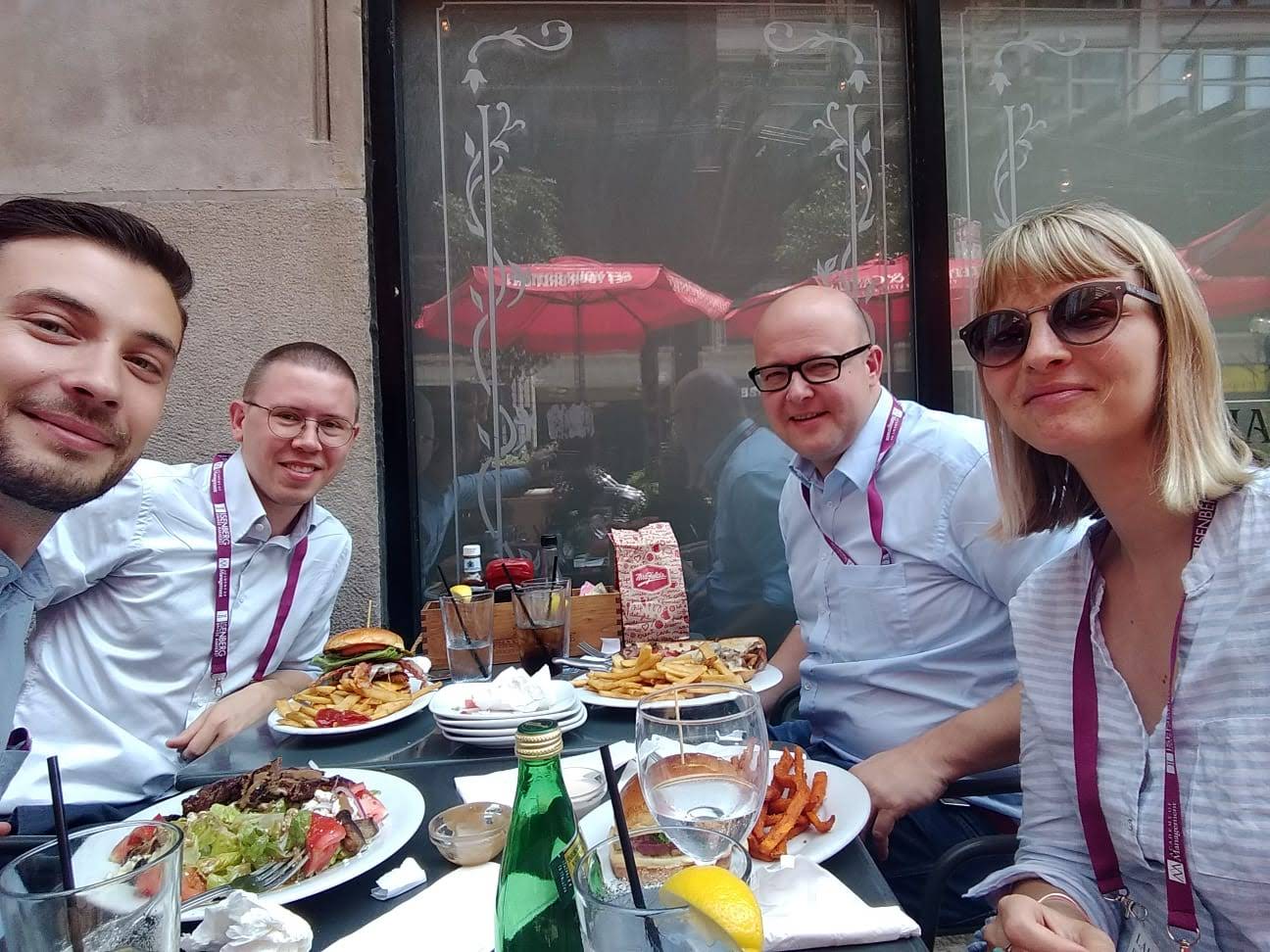
As usual, healthy food is one of the best things about any visit to the US, here together with Blagoy Blagoev (University of Lüneburg), Maximilian Heimstädt (University of Witten/Herdecke) and my sister and co-author Laura (Radboud University, Nijmegen, NL)
Every other year (see post on the last visit in 2016) I enjoy taking part in the Academy of Management Annual Meeting, the world’s largest conference for management and organization studies scholars. This year the conference took place in Chicago. The following list is about my main activities there:
I was given the opportunity to take part as a facilitator in a Professional Development Workshop of the Strategizing Activities and Practices (SAP) Interest Group on “Advancing SAP Research”.
In the same session entitled “Expanding the Boundaries of Open Strategizing“, I was also invited to act as a commentator on each of the other three papers in the session, all of which offered new perspectives and great empirical data on openness in strategy-making.
Interestingly and as a potential long-term save-the-date, the Academy of Management announced that for the first time in its history, the conference will take place in Europe – more specifically, in Copenhagen – in 2025. I am really looking forward to this event, albeit being curious how Copenhagen will manage to cope with hosting so many management and organization scholars at once. Probably should already think about booking a hotel room.. 😉
My sister, Laura (Radboud University in Nijmegen, NL), our colleague Gordon Müller-Seitz (TU Kaiserlautern), and I have looked at an open strategy-making process of Wikimedia, the non-profit foundation behind the free online encyclopedia Wikipedia. In the paper “Closing for the Benefit of Openness?“, which is now open access available at the journal Organization Studies, we find that “simply” opening up preexisting organizational processes tends to reproduce or even reinforce social inequalities already in place. To enable broad participation and to reach out to particularly marginalized groups, openness is depending on certain forms of (procedural) closure. Pleas find the abstract of the paper below:
A growing number of organizations subscribe to ideals of openness in areas such as innovation or strategy-making, supported by digital technologies and fuelled by promises of better outcomes and increased legitimacy. However, by applying a relational lens of inclusion and exclusion, we argue that, paradoxically, certain forms of closure may be necessary to achieve desired open qualities in strategy-making. Analysing the case of Wikimedia, which called for participation in a globally open strategy-making process, we show that openness regarding participation in crafting strategy content depends on certain forms of closure regarding procedures of the strategy-making process. Against this background, we propose a two-dimensional framework of openness, in which content-related and procedural openness are characterized by a combination of open and closed elements.
Thanks to an open access agreement between Dutch universities and the publisher Sage, the fulltext is open availble.








 ConJunction