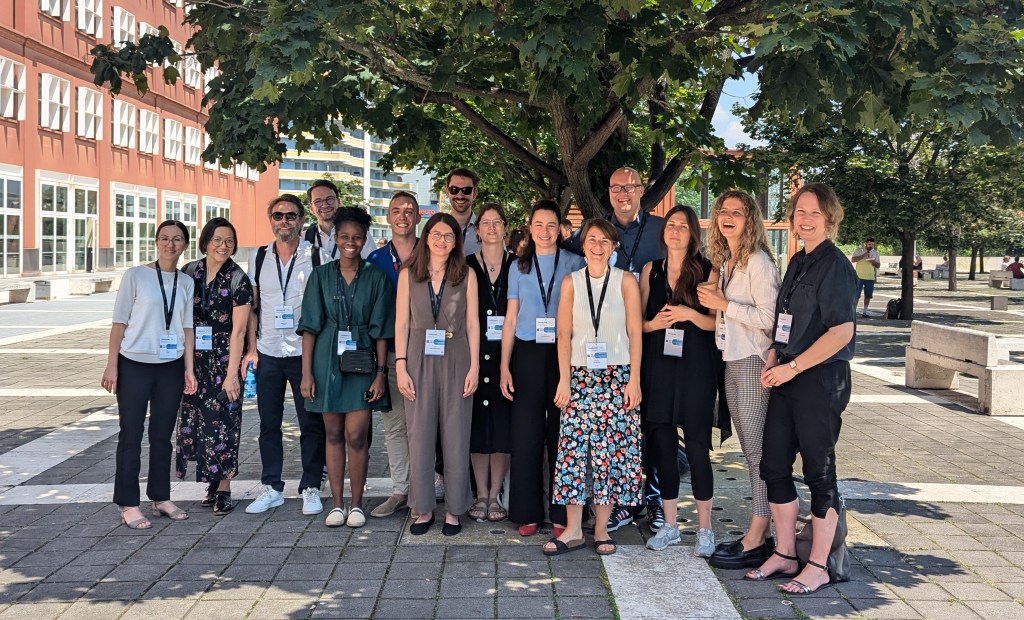
The motto of the 40th Colloquium of the European Group of Organization Studies (EGOS) in Milan was “Crossroads for Organizations: Time, Space and People.” To some degree, the group photo above is exactly the result of organizing time and space at a crossroads to gather all participants related to University of Innsbruck’s Department of Organization and Learning that were contributing to the event.
The 40th EGOS Colloquium will take place from July 4-6, 2024, in Milan, Italy, and I am very happy to co-convene a sub-theme with Anne K. Krüger (Berlin-Brandenburg Academy of Sciences and Humanities) and Neil Pollock (University of Edinburgh Business School, UK). Please find the Call for Short Papers (about 3.000 words) of sub-theme 61 on “Reorganizing Knowledge Practices in the Digital Era: Driven by Data, Out in the Open?” below, submission deadline is January 09, 2024. Please also have a look at the submission guidelines.
Organizations produce, offer and structure knowledge that not only provides us with new insights but also triggers new developments. They display information that is supposed to support decision-making of people, enterprises, or politicians ranging from statistic reports, e.g. on demographic developments (Desrosières 1998), evaluation, e.g. of the credit-worthiness of individuals and nation states (Besedovsky 2018; Kiviat 2019) or of the performance of hospitals (Reilley and Scheytt 2019) and prisons (Mennicken 2013) to rankings of start-ups (Pollock and D’Adderio 2012), universities (Espeland and Sauder 2016; Wilbers and Brankovic 2021) or entire cities (Kornberger and Carter 2010). Much of our “knowledge about the world” is provided by organizations and highly organized processes. Particularly in times of perceived uncertainty and existential environmental threats (Bacevic 2021) such knowledge is having a crucial effect on our understanding of social problems and possible solutions.
Yet, in light of mounting demands for open access, open source, open data and open science (Bacevic and Muellerleile 2018; Dobusch et al., 2023) as well as increasing accumulation of mass data and their automated analysis (Crawford 2021), digitization presents a crucial crossroad for organizational knowledge production. These developments reorganize the ways how and which kind of knowledge is produced and offered. They not only amplify the possibilities of knowledge production in organizations and of access to knowledge through organizations but also allow for entirely new and very diverse forms of organizing knowledge creation and distribution, ranging from algorithm- and AI-based to volunteer- and crowd-driven. They furthermore influence what counts as knowledge, who has the authority to provide knowledge and how this knowledge informs our decisions and perception of what counts, e.g. as a trustworthy seller (Kornberger et al. 2017), as excellent science (Krüger and Petersohn 2022) or simply as good music (Alaimo and Kallinikos 2020).
Last week, Monica Nadegger, Katharina Zangerle, and Milena Leybold (University of Innsbruck, Department for Organization and Learning) traveled to the beautiful island Sardegna to meet for four days with around 2000 people at the Colloquium of the European Group of Organization Studies.
From the left: Monica Nadegger, Milena Leybold, Katharina Zangerle
The European Group of Organization Studies (EGOS) Symposium 2022 took place on the WU Campus in Vienna. (Photo: Marilyn Poon)
I follow quite a few academia-related accounts on Twitter (the hazards of doing digital methods). Just before embarking on my first conference this summer, I came across a tweet by a PhD student (in an anonymized fashion) asking: what’s the big deal about going to conferences anyway?
Over the course of the past decade, we can observe a growing trend towards (calls for) greater openness in various organizational contexts such as open innovation, open government, open strategy or open science. To some degree openness has been recast as a programmatic organizing principle, promising not just gains in efficiency (e.g., Chesbrough & Appleyard, 2007) but also in terms of transparency (Ohlson & Yakis-Douglas, 2019), accountability (Whittington, 2019) and inclusiveness (Mack & Szulanski, 2017). At the same time, we can observe a growing body of literature on diversity and inclusion that addresses openness in terms of inclusive organizing (Ferdman & Deane, 2014; Mor Barak, 2016; Nkomo et al., 2019; Shore et al., 2018; Zanoni et al., 2010).
Particularly regarding inclusiveness, however, we see a detachment of research on openness in various organizational contexts (e.g. strategy or innovation) from other scholarly debates on diversity and inclusion that address inclusive organizing as such (for an exception see Dobusch et al., 2019). With this sub-theme we seek to make a connection between these two separate research streams because we see three particular avenues for crosspollination that will advance our knowledge about inclusion, diversity and open organizing:
The annual Colloquium of the European Group of Organization Studies (EGOS) is a great opportunity to engage with a great variety of research communities. In 2019 University of Innsbruck’s department of organization and learning was represented with a record number of participants. Please find an overview of our contributions to this year’s EGOS Colloquium below.
Please find below the Call for Papers for a Special Issue in Organization Studies on “Open Organizing in an Open Society? Conditions, Consequences and Contradictions of Openness as an Organizing Principle” (PDF), co-edited by Georg von Krogh, Violetta Splitter, Peter Walgenbach, Richard Whittington and myself. In case you are interested to submit a paper to the Special Issue, please also consider to submit a short paper version of it to the upcoming EGOS sub-theme 55 on “Open Organizing for an Open Society? Connecting Research on Organizational Openness” . Submitting authors are not in any way obliged to participate at this sub-theme, and papers presented at the sub-theme are not guaranteed publication in the Special Issue. We just see this sub-theme as an opportunity to develop papers for submission. Deadline for submitting short papers to the EGOS sub-theme is January 14, 2019, deadline for submitting manuscripts to the Special Issue in Organization Studies is November 30, 2019. Continue reading “Call for Papers for a Special Issue in Organization Studies: »Open Organizing in an Open Society?«”→
Discussions around open organizing date back to the 1950s, when organizations were conceptualized as open systems interdependent with their environments (e.g. Boulding, 1956). However, recent developments have seen openness recast as an organizing principle in a wide range of domains. Indeed, Tkacz (2012, p. 400) describes contemporary advanced societies as undergoing a “second coming of openness”. Thus we see the apparent rise of phenomena such as open innovation (Chesbrough, 2006), open strategy (Hautz et al., 2017), open software development (von Hippel & von Krogh, 2006), open government (Janssen et al., 2012), open science (Nosek et al., 2015), and open education (Seely et al., 2008).
While there is growing reference to notions of openness across domains, these are largely disconnected from each other, show few signs of convergence and lack theoretical reference between domains. This fragmentation is even more marked when considering related notions such as organizational fluidity (Dobusch & Schoenborn, 2015), liquidity (Kociatkiewicz & Kostera, 2014), boundlessness (Ashkenas et al., 2002) and partiality (Ahrne & Brunsson, 2011). Alongside these notions, advanced societies appear also to be seeing the emergence of more open organizational forms such as crowds (Felin et al., 2014), communities (Faraj et al., 2016), ecosystems (Baldwin, 2012) or meta-organizations (Gulati et al., 2012). A central objective of the proposed sub-theme will be to bring together discussions of various forms of open organizing in order to explore possible commonalities and significant distinctions, and to develop means for more connected theorizing across domains and dimensions. Continue reading “EGOS 2019 Call for Short Papers: »Open Organizing for an Open Society?«”→
The 33rd EGOS Colloquium will take place from July 6–8, 2017 in Copenhagen, Denmark, and together with Georg von Krogh (ETH Zürich) and Richard Whittington (Oxford University) I will be convenor of sub-theme 50 on “Open Strategy: Practices, Perspectives and Problems“. Please find the Call for Short Papers below, submission deadline is January 9, 2017:
Many organizations in public, private and non-for-profit sectors are becoming more transparent about their strategies, while also including a wider range of actors in strategy development. These moves involve a variety of strategy practices, for example strategy jamming (Bjelland & Wood, 2008), strategy crowdsourcing (Stieger et al., 2012), strategy blogs and wikis (Dobusch & Kapeller, 2013) or strategy simulations in online games (Aten & Thomas, 2016). Although involving many different practices, this phenomenon has been described most comprehensively as ‘open strategy’ (Chesbrough & Appleyard, 2007; Whittington et al., 2011).
Building upon these studies, recent works on open strategy have begun to look at open strategy from an increasing variety of perspectives such as impression management (Whittington et al., 2016), middle-management inclusion in strategy-making (Wolf et al., 2014) or the inter-organizational explorations of strategic issues (Werle & Seidl, 2015). However, systematic cross-fertilization between the emerging open strategy literature and other areas and concepts of organizational openness are still rare. Continue reading “EGOS Sub-theme Call for Papers: »Open Strategy: Practices, Perspectives and Problems«”→





 ConJunction