Professor of Organization at University of Innsbruck | Co-founder Momentum Conference and Momentum Institut | ZDF Verwaltungsrat | Blogging at netzpolitik.org
In den letzten Jahren habe ich auf der spannendsten Digitalkonferenz Europas, der re:publica in Berlin, über Medienwandel im Allgemeinen und die digitale Transformation öffentlich-rechtlicher Medien im Besonderen gesprochen. Auch dieses Jahr habe ich gemeinsam mit NDR-Rundfunkrätin Beate Bäumer ein Meetup für “Öffentlich-Rechtliche auf der re:publica” moderiert, wobei der Fokus darauf lag, “Was Aufsichtsgremien jetzt lernen müssen. Erfahrungen und Tipps.”
Mein Hauptvortrag widmete sich jedoch jenem Thema, das mich im letzten Jahr mit Sicherheit am meisten beschäftigt hat: der Analyse und Erklärung des finanzialisierten Geschäftsmodells von René Benkos Signa-Gruppe.
Led by Katharina Zangerle, who collected data at a large pharmaceutical corporation in Austria and Switzerland, we are very happy to announce the first joint article by three members of the organization unit at the Department of Organization and Learning, as Katharina had teamed up with Richard Weiskopf and myself for crafting the article.
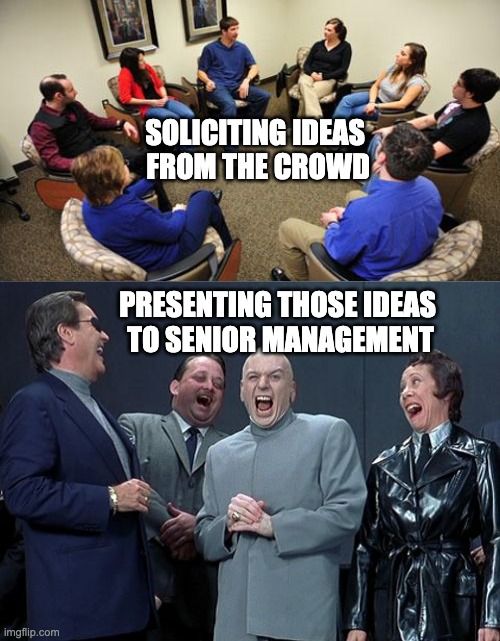
Attributing value to ideas is central in the journey from generating and elaborating ideas, to realising ‘creative’ products and processes. In this study, we explore the ways in which ideas are attributed value through practices of valuation in the innovation process. We examine valuation practices and intentionally and deliberately designed digital and analog spaces in pharmaceutical innovation across various stages of the ‘idea journey’. The findings shed light on the valuation of objects and emerging ideas as well as unveiling how pharmaceutical firms adapt valuation practices in times of crisis, when the imperative to generate novel solutions intensifies. The empirical case illustrates the interplay between ‘opening’ valuation practices, such as crowd votings facilitated by a digital ideation software, and ‘closing’ mechanisms, such as idea rankings within exclusive evaluation boards, or idea clustering through the digital device, as well as how these practices enable a working consensus on defining what qualifies as new and valuable within the organisation. While closing valuation with its quantifying practices might allow for efficient decision-making in organising novelty, it may turn out to be problematic when it comes to achieving organisational legitimacy in innovation processes. Balancing opening and closing mechanisms seems crucial in innovation processes, particularly in times of uncertainty. Taking a closer look at the spatial and temporal conditions and dynamics of valuation, as well as the role of digital technology in the production of value advances the understanding of how value is produced.
The research has been conducted in the realm of joint DFG and FWF research project on “Organized Creativity” and regulatory uncertainty in music and pharma.
While most academics and journalists, just like everybody else, heavily relies on Wikipedia for both private and professional purposes, it is quite common in among both these groups to scold anyone who openly admits doing so. For example, many lecturers tend to make fun of students citing Wikipedia and pride themselves in educating them that “Wikipedia is not a source” and, thus, cannot be cited in a seminar paper.
I not only strongly disagree with both tone and substance of such statements, but I regularly have to deal with insecurity and uncertainty among students with respect to the proper use of Wikipedia. The following list presents the five main points I try to bring across in such situations.
In der Festrede anlässlich der Verleihung der Otto-Brenner-Preise für kritischen Journalismus 2023 habe ich in der laufenden Debatte eine provokant-optimistische These vertreten: Die besten Zeiten öffentlich-rechtlicher Medien liegen noch vor uns.
Hauptgrund für mein Interesse am Geschäftsgebaren der in Innsbruck ansässigen Signa Holding sowie deren weitverzweigtem Geflecht an Unternehmensbeteiligungen ist meine Forschung zu finanzialisierten Geschäftsmodellen im Immobiliensektor. Anlässlich der jüngsten wirtschaftlichen Turbulenzen der Signa-Gruppe, habe ich im Moment Magazin versucht, einige häufige Fragen zum Fall so einfach wie möglich zu beantworten:
Warum ist René Benkos Signa-Gruppe in wirtschaftlichen Schwierigkeiten?
Warum steckt sie offenbar in größeren Schwierigkeiten als andere Immobilienunternehmen?
Warum fällt es Signa so schwer, neue Kapitalgeber zu finden?
Wer zahlt eigentlich am Ende drauf, sollte Signa Pleite gehen?
Außerdem habe ich mich in einer Reihe von Medieninterviews bemüht, die Hintergründe zu erklären und Einschätzungen zur weiteren Entwicklung abgegeben:
Screenshot of Last Week Tonight segment on “McKinsey” (at about 25:36)
John Oliver’s Last Week Tonight with its well-researched and in-depth segments of journalism in satire’s clothing regularly manages to escape the 24-hour news cycle and instead set the agenda themselves. And if John Oliver takes on large consulting firms in general and McKinsey in particular, it is a must-watch for any student and scholar of management and organization studies. Check it out:
I would have enjoyed this piece very much, hadn’t it been all too accurate a depiction of systemic deficiencies in our contemporary corporate world. And while I really applaud the way the segment demonstrates that the problem with McKinsey is not one of “bad apples” but rather systemic, indeed, it does not really offer suggestions on how to improve the situation.
The 40th EGOS Colloquium will take place from July 4-6, 2024, in Milan, Italy, and I am very happy to co-convene a sub-theme with Anne K. Krüger (Berlin-Brandenburg Academy of Sciences and Humanities) and Neil Pollock (University of Edinburgh Business School, UK). Please find the Call for Short Papers (about 3.000 words) of sub-theme 61 on “Reorganizing Knowledge Practices in the Digital Era: Driven by Data, Out in the Open?” below, submission deadline is January 09, 2024. Please also have a look at the submission guidelines.
Organizations produce, offer and structure knowledge that not only provides us with new insights but also triggers new developments. They display information that is supposed to support decision-making of people, enterprises, or politicians ranging from statistic reports, e.g. on demographic developments (Desrosières 1998), evaluation, e.g. of the credit-worthiness of individuals and nation states (Besedovsky 2018; Kiviat 2019) or of the performance of hospitals (Reilley and Scheytt 2019) and prisons (Mennicken 2013) to rankings of start-ups (Pollock and D’Adderio 2012), universities (Espeland and Sauder 2016; Wilbers and Brankovic 2021) or entire cities (Kornberger and Carter 2010). Much of our “knowledge about the world” is provided by organizations and highly organized processes. Particularly in times of perceived uncertainty and existential environmental threats (Bacevic 2021) such knowledge is having a crucial effect on our understanding of social problems and possible solutions.
Yet, in light of mounting demands for open access, open source, open data and open science (Bacevic and Muellerleile 2018; Dobusch et al., 2023) as well as increasing accumulation of mass data and their automated analysis (Crawford 2021), digitization presents a crucial crossroad for organizational knowledge production. These developments reorganize the ways how and which kind of knowledge is produced and offered. They not only amplify the possibilities of knowledge production in organizations and of access to knowledge through organizations but also allow for entirely new and very diverse forms of organizing knowledge creation and distribution, ranging from algorithm- and AI-based to volunteer- and crowd-driven. They furthermore influence what counts as knowledge, who has the authority to provide knowledge and how this knowledge informs our decisions and perception of what counts, e.g. as a trustworthy seller (Kornberger et al. 2017), as excellent science (Krüger and Petersohn 2022) or simply as good music (Alaimo and Kallinikos 2020).
Das Ö1-Radiokolleg dreht sich diese Woche um das Thema “Unser Geld: Wie umgehen mit Schulden?”. In der zweiten Folge durfte ich vergleichsweise ausführlich über (unvermeidbare) Sozialisierung von Verlusten bei Insolvenzen sowie die verzögerte Wirkung von Leitzinserhöhungen für Unternehmenspleiten sprechen. Einer von mehreren O-Tönen:
“Es wird eine Zeit dauern, bis die bereits erfolgten Zinserhöhungen sich auch auswirken, weil die Unternehmen ja auch längere Laufzeiten bei ihren Krediten haben und das ganze erst dann schlagend wird, wenn der Kredit ausläuft und refinanziert werden muss, und dann auf einmal die höheren Zinskosten aber nicht unbedingt mit höheren Einnahmen korrespondieren. Das ist auch der Grund, warum man hier auch Kaskaden von Insolvenzen sehen könnte, zum Beispiel im Bereich der Immobilienwirtschaft. Warum? Wir erleben derzeit, dass im Handel, als Spätfolge von Corona, aber auch durch den allgemeinen Strukturwandel hin zum Online-Handel, diese enorm hohen Mieten, die im Bereich von guten Lagen verlangt werden, einfach für Handelsunternehmen nicht mehr refinanzierbar sind. Das bedeutet, wir sehen hier Pleiten von Handelsunternehmen oder auch nur einen Rückzug aus bestimmten Lagen, und das wird dazu führen, dass in den nächsten zwei, drei Jahren, Immobilienbesitzer vor dem Problem stehen werden, dass sie keine Nachmieter finden, die ihre Mieten in den gewünschten Höhen erzielen. Was aber dann wiederum bedeutet, dass die Mieten sinken. Und wenn die Mieten sinken, lässt sich die Bewertung von Immobilien nicht mehr aufrecht erhalten. Was bedeutet, meine Immobilie wird weniger wert. Der Kredit geht aber nicht weg, der verschwindet nicht. Und wenn ich diesen Immobilienkredit dann refinanzieren muss, meine Immobilie aber weniger wert ist, als zuvor, dann wird das nicht mehr funktionieren. Und dann führen quasi die Handelspleiten zu Beginn zu Immobilienpleiten im nächsten Schritt.”
University of Zurich and Oxford University’s Said Business school host a joint workshop that “aims to bring together Open Strategy scholars and practitioners to discuss ongoing and future research projects”. The workshop is scheduled for July 1-2, 2024, right before the EGOS Colloquium in Milano that year and will be located at University of Zurich.
Participation requires the submission of extended abstracts (2,000 words) by January 25, 2024 to os@business.uzh.ch.
For more information on the workshop check out the website.