Over ten years ago, Journal of Management Studies published Dennis Schoenborn and my article on “Fluidity, Identity & Organizationality: The Communicative Constitution of Anonymous.” It turned out to become not only my most cited piece of scholarly work but really started a conversation on how we should conceptualize organization: as an entity (organization), as a process (organizing) or rather as property of social phenomena (organizationality).
Not long after the article had been published, Dennis and I started to work on a theoretical follow-up to spell out what we had only claimed but not fully conceptualized: understanding organisation as a matter of degree. Over seven years since we started this endeavour and after teaming up with David Seidl, I am extremely happy and proud that “Toward a Theory of Organizationality: A Gradual View on Collective Actorhood” has been accepted for publication at Organization Theory and is available open access as a preprint version. The abstract summarizes our main points:
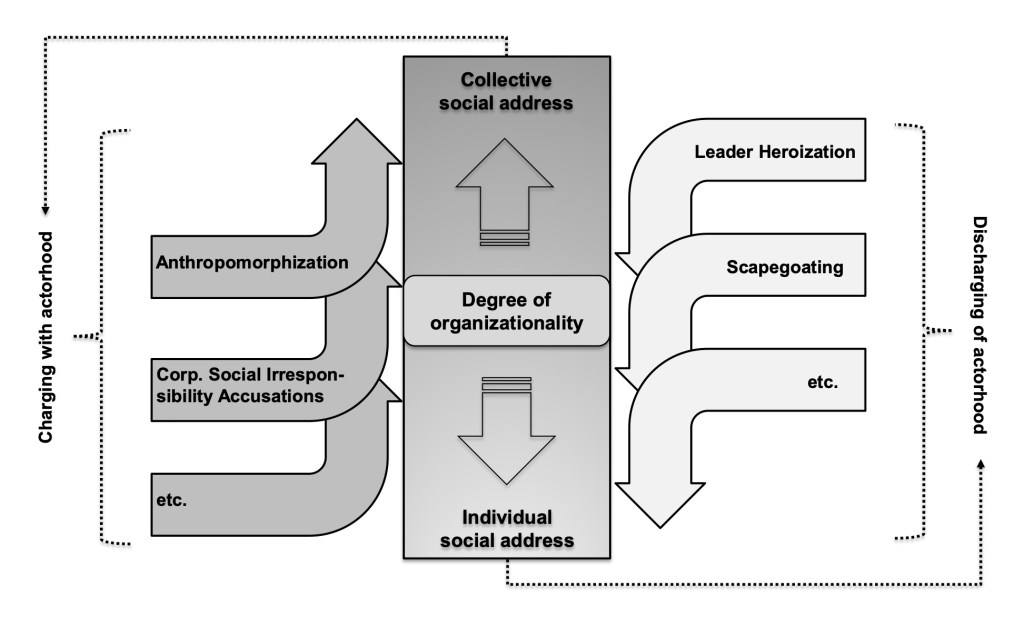
This paper addresses a central dilemma in organizational theory of how to conceptualize organization in a way sufficiently specific to distinguish it from other social phenomena yet sufficiently flexible to account for new organizational forms. Traditionally, there has been a split between scholars advocating a narrow understanding of organizations as entities and scholars arguing for a broader understanding of organizing as a processual phenomenon. While an overly narrow approach risks rendering organization studies irrelevant by failing to account for new organizational phenomena, an excessively broad view risks blurring the distinction between organization and sociality in general. To resolve this dilemma, we advance a third-way approach based on the concept of organizationality – a gradual notion of organization, understood as a quality that social collectives may possess to a higher or lower degree. In particular, we develop the contours of a theory of organizationality grounded in a gradual understanding of collective actorhood. Higher and lower degrees of organizationality, in turn, depend on practices of attributing actorhood to a collective or to an individual social address. By proposing collective actorhood as the main axis of organizationality that can vary in degree over time, we offer a theoretical framework that preserves the specificity of organization as a concept while accounting for a broader range of new organizational phenomena, as well.
At the same time, this is the perfect occasion to once more point toward the open call for papers in Business & Society on “Collective Actorhood and Organizationality” with the deadline for submissions set at September 30, 2026.
 ConJunction