New Article in Information & Organization: »Digital platforms and democratic publics: How social media platforms selectively appropriate and strategically subvert institutional logics«

Cover of the Journal "Information & Organization"

One reason why it is so hard to reign into Big Tech social media platforms is their own contradictions. In a brand new article by Elke Schüßler, Sara Maric and myself, we try to unpack how Big Tech both expand and subvert democratic publics by looking at the case of YouTube – and explore the potentials and challenges of Fediverse alternatives based on decentralized architectures and distributed governance.

The issue is that both is true at the same time: YouTube has expanded our democratic public by lowering barriers for content creation and distribution; and it also has subverted our democratic public by amplifying extremist, emotionalising or propagandistic content.

To give another example, it is YouTube’s monopolistic market dominance is that makes it so strong and valuable as a market place for creators and users alike; at the same time, the proprietary governance by profit-driven algorithms leads to discriminatory practices such as shadow bans without accountability, frustrating both creators and users.

Continue reading “New Article in Information & Organization: »Digital platforms and democratic publics: How social media platforms selectively appropriate and strategically subvert institutional logics«”
Digital Democracy Day 2025: Interview und Impuls

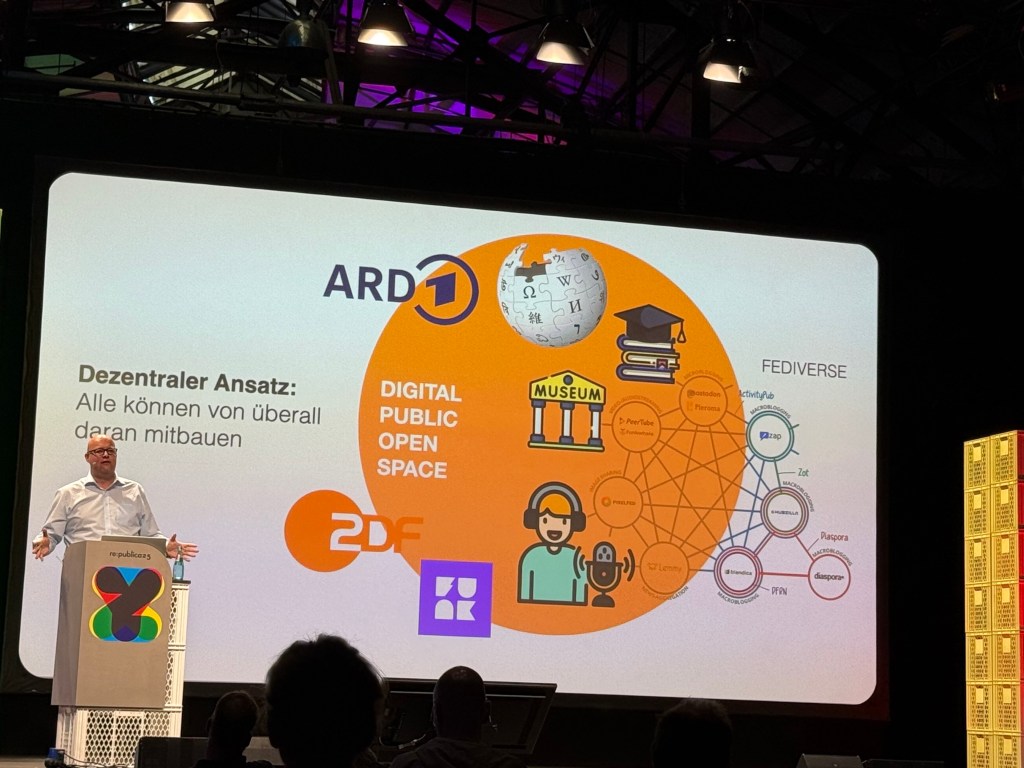
Screenshot Online-Impuls im Rahmen des Digital Democracy Day 2025

Am 6. November 2025 fand in Berlin zum ersten Mal der #DigitalDemocracyDay2025 statt. Ich durfte mit einem kurzen Online-Impuls zum Thema “Von Wikipedia für Digitale Demokratie lernen” mit dabei sein (Slides). Bereits vorab hat Bernhard Seiler für SWR Aktuell Radio mit mir zum Thema gesprochen – das Interview findet sich hier zum Nachhören:

Die Aufzeichnung des Livestreams der Veranstaltung ist bereits online, mein Beitrag beginnt ungefähr bei 1h40 Minuten:

Im Folgenden meine Vortragsnotizen für all jene, die lieber lesen als schauen:

Continue reading “Digital Democracy Day 2025: Interview und Impuls”

re:publica 2025: Zombies im Rundfunkrecht, rechtskommerzielles Tingeltangel und Governance von offen Digitalinfrastrukturen

Bei der jährlich in Berlin stattfindenden re:publica-Konferenz zur digitalen Gesellschaft werden die Bühnen nicht an Meistbietende verkauft, sondern größtenteils von ehrenamtlichen Track-Teams kuratiert. Umso größer die Ehre, dass ich auch dieses Jahr wieder Teil des Programms sein durfte.

In meinem Vortrag “Von Presseähnlichkeit zu öffentlich-rechtlicher Innovation” (Öffnet in neuem Fenster) habe ich mich vor allem mit immer noch bestehenden gesetzlichen Einschränkungen – Zombie-Regulierungen – für öffentlich-rechtliche Online-Angebote vor allem im Informations- und Nachrichtenbereich auseinandergesetzt. Während private Medienanbieter seit den 1970er Jahren für Einschränkungen öffentlich-rechtlicher Medien zum Schutz ihrer Geschäftsmodelle lobbyieren, lässt sich seither eine enorme Ausdehnung der Sphäre privat-kommerzieller Medien beobachten.

Continue reading “re:publica 2025: Zombies im Rundfunkrecht, rechtskommerzielles Tingeltangel und Governance von offen Digitalinfrastrukturen”

Join the Organidons: Organization and Management Scholars on Mastodon

This is what Open AI makes out of the instruction “organization scholarship in the style of digital retro art”

With its decentralized and non-profit nature, the Fediverse in general and Mastodon in particular provide a fitting and low-threshold opportunity to follow interesting researchers and practitioners, stay in touch with colleagues and share research output with the world. However, for a social network to thrive, it requires a critical mass of active users. To make it easier to find and (re-)connect with fellow organization and management scholars on Mastodon, we have launched the Organidons project: a curated opt-in only list of organization and management scholars on Mastodon.

The creation of this list was inspired by the collection of lists at Academics on Mastodon over at Github.

In addition, we have also extracted via fedifinder those people who are following the account of the journal Organization Studies on Twitter (@osofficer) and have put their Mastodon handle in their Twitter profile to be found there. Check out this list to get an overview of some people who are already on Mastodon (this list is static and won’t be updated in the future).