Location of the 3rd Open Strategy Workshop in Innsbruck (Credit: Leonhard Lenz, CC0)
After the first two workshops gathering Open Strategy scholars took place in Zurich (2024) and Oxford (2025), we are excited to announce the 3rd workshop will be hosted by University of Innsbruck on June 25-26, 2026. The call for extended abstractsis already live. Your extended abstract should align with the general theme of Open Strategy and must not have been previously published. Authors of accepted abstracts will have the opportunity to attend the two-day workshop in person and apply for poster presentations. To ensure high-quality exchanges and foster meaningful connections, on-site participation is limited.
Ten years after Dennis Schoeneborn and I had introduced the idea of ‘organizationality’ to conceptualize organization as a matter of degree in our joint article “Fluidity, Identity and Organizationality”, we have teamed up with Héloïse Berkowitz, Frank de Bakker and Consuelo Vásquez for a special issue on “Collective actorhood and organizationality: Recalibrating responsibility in business-society relations” (PDF of the Call) to be published in Business & Society. We will be supported in the editorial work by consulting editor Devi Vijay as well as Business & Society editor Colin Higgins. Deadline for submissions is September 30, 2026. Please check out the full call for papers below:
Call for Papers for a Special Issue in Innovation: Organization & Management
Konstantin Hondros (HSU Hamburg), Astrid Mager (Austrian Academy of Sciences), Patricia Aufderheide (American University Washington), Patrick Cohedent (HEC Montréal) and myself are happy to announce a Call for Paper for a special issue on “Creativity and copyright in the shadow of GenAI: Managing and organizing creative content in the digitalization frenzy” to be published in “Innovation: Organization & Management”. Deadline for submission of full papers is September 30, 2026. Please do not hesitate to contact me or one of the other editors to discuss paper ideas.
In addition, we are planning an online paper development workshop to provide feedback on early-stage submissions on February 27, 2026. We encourage potential authors to submit an abstract of approximately 1,000 words describing their planned contribution, empirical material, and methodological approach (if applicable) by January 25, 2026, to konstantin.hondros@hsu-hh.de. Participation in the workshop is optional, and authors who do not attend are welcome to submit papers to the Special Issue.
The 40th EGOS Colloquium will take place from July 4-6, 2024, in Milan, Italy, and I am very happy to co-convene a sub-theme with Anne K. Krüger (Berlin-Brandenburg Academy of Sciences and Humanities) and Neil Pollock (University of Edinburgh Business School, UK). Please find the Call for Short Papers (about 3.000 words) of sub-theme 61 on “Reorganizing Knowledge Practices in the Digital Era: Driven by Data, Out in the Open?” below, submission deadline is January 09, 2024. Please also have a look at the submission guidelines.
Organizations produce, offer and structure knowledge that not only provides us with new insights but also triggers new developments. They display information that is supposed to support decision-making of people, enterprises, or politicians ranging from statistic reports, e.g. on demographic developments (Desrosières 1998), evaluation, e.g. of the credit-worthiness of individuals and nation states (Besedovsky 2018; Kiviat 2019) or of the performance of hospitals (Reilley and Scheytt 2019) and prisons (Mennicken 2013) to rankings of start-ups (Pollock and D’Adderio 2012), universities (Espeland and Sauder 2016; Wilbers and Brankovic 2021) or entire cities (Kornberger and Carter 2010). Much of our “knowledge about the world” is provided by organizations and highly organized processes. Particularly in times of perceived uncertainty and existential environmental threats (Bacevic 2021) such knowledge is having a crucial effect on our understanding of social problems and possible solutions.
Yet, in light of mounting demands for open access, open source, open data and open science (Bacevic and Muellerleile 2018; Dobusch et al., 2023) as well as increasing accumulation of mass data and their automated analysis (Crawford 2021), digitization presents a crucial crossroad for organizational knowledge production. These developments reorganize the ways how and which kind of knowledge is produced and offered. They not only amplify the possibilities of knowledge production in organizations and of access to knowledge through organizations but also allow for entirely new and very diverse forms of organizing knowledge creation and distribution, ranging from algorithm- and AI-based to volunteer- and crowd-driven. They furthermore influence what counts as knowledge, who has the authority to provide knowledge and how this knowledge informs our decisions and perception of what counts, e.g. as a trustworthy seller (Kornberger et al. 2017), as excellent science (Krüger and Petersohn 2022) or simply as good music (Alaimo and Kallinikos 2020).
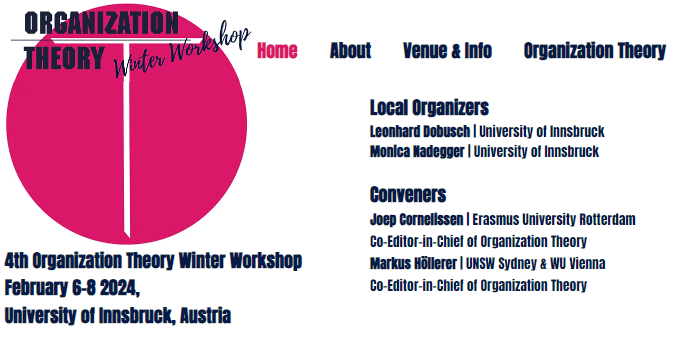
We are happy to announce that we will host the 4th OT Winter Workshop from February 6-8, 2024, at the University of Innsbruck. The OT Winter Workshop aims to advance research on organizational theory and further develop potential submissions to the journal “Organization Theory” (OT). The workshop will offer detailed coaching and hands-on feedback sessions as well as plenary sessions on crucial topics with regard to developing and writing theory with the members of the OT Editorial board.
University of Zurich and Oxford University’s Said Business school host a joint workshop that “aims to bring together Open Strategy scholars and practitioners to discuss ongoing and future research projects”. The workshop is scheduled for July 1-2, 2024, right before the EGOS Colloquium in Milano that year and will be located at University of Zurich.
Participation requires the submission of extended abstracts (2,000 words) by January 25, 2024 to os@business.uzh.ch.
For more information on the workshop check out the website.
The First Creativity Paper Development Workshop is an opportunity for academics to develop their ongoing work, empirical or conceptual, related to creativity, broadly defined. The workshop will be developmental with each paper having as a discussant a senior scholar with a track record of multiple publications in creativity. Authors will also receive feedback from peers with similar research interests. It should be of special interest to colleagues who recently graduated with a Ph.D., and doctoral students with quite well-developed manuscripts; scholars more advanced in their careers are also welcome to attend. This workshop aims to become an annual opportunity for early scholars in Business/Management to establish themselves in the vibrant international community of scholars interested in the study of creativity. It aims to initiate and support a budding community of Europe-based researchers with a shared interest in creativity and to offer them an environment to come together, know each other as well as established scholars, benefit from close interpersonal relations, and initiate new exciting collaborations. We see this workshop as an opportunity to develop a standing working group on creativity, especially among Central and Southern European Universities.
Deadline for submitting applications based on abstracts of around 500 is 11.59 pm, January 25th, 2023. Email for submission: creativity@jku.at.
Bei dem Infoevent “Gemma’s an? Auslandssemester!” am 24.11. 2022, 13:45-15:00, HS7 (Geiwi-Turm) erfahren Interessierte alles rund um das Thema Auslandsaufenthalt im Studium. Die Veranstaltung ist als Hybrid Event geplant. Studierende können den Livestream via OLAT mitverfolgen.
At the 42nd Strategic Management Conference in London, the paper “Taking individual choices seriously: Self-selection and the coordination of strategy work” co-authored by Martin Friesl, Christoph Brielmaier (both University of Bamberg) and myself, was awarded the Best Paper Award of the Strategy Practice Interest Group of the Strategic Management Society (SMS). Christoph was so kind to collect our award certificate in London.
The Abstract of the paper reads as follows:
An increasing body of work investigates the participation of a diverse set of actors in strategy making. There is also a converging view in strategy practice and process research that diverse participation in the strategy process has positive implications for corporate renewal and success. In this paper, we argue that extant research tends to gloss over a fundamental condition underpinning participation in such types of strategizing: participation does largely do not involve a hierarchical mandate but is the result of processes of self-selection on the individual level. While this may seem self-evident, it is of crucial importance. These forms of strategizing are, therefore, not the outcome of deliberate top-down choice, nor do they form a ‘random’ pattern. Rather, they are based on an ‘endogenous’ logic, which explains whether an individual self-selects into the process or not. Thus, it is this logic of self-selection that ultimately gives rise to strategic outcomes. This paper aims to make three contributions to strategy practice and process research. It differentiates two forms of self-selection (managed and unmanaged) and describes their implications on the level of the organization and the level of the individual. Moreover, this paper also theorizes the underlying mechanisms governing selection choices.
We are currently revising the article for publication in a journal. In case you are interested in the conference paper, I am happy to provide it via e-mail.
Hosted by the the Business & Society Program within the renowned Aspen Institute, the “Ideas Worth Teaching Award” is one of the most prestigious awards for teaching in business and management education. And I am very happy and proud to announce that the collaborative open course “Organizing in Times of Crisis” is among the winners of the 2020 competition – selected out of over 100 nominations.
As recipients of the award, Elke Schüßler (University of Linz) and myself had the honor to introduce our joint course in no longer than 45 seconds:







 ConJunction
