In Memoriam: Paul Zimmermann

It is with great sadness that we share the news that Paul Zimmermann, a valued member of the Organization Studies Innsbruck community, lost his life in an avalanche.

After finishing the Organization Studies Master’s program, Paul successfully completed his PhD (Management) in December 2025. In his dissertation, he critically studied the phenomenon of whistleblowing and how it is regulated and enacted in organizations.
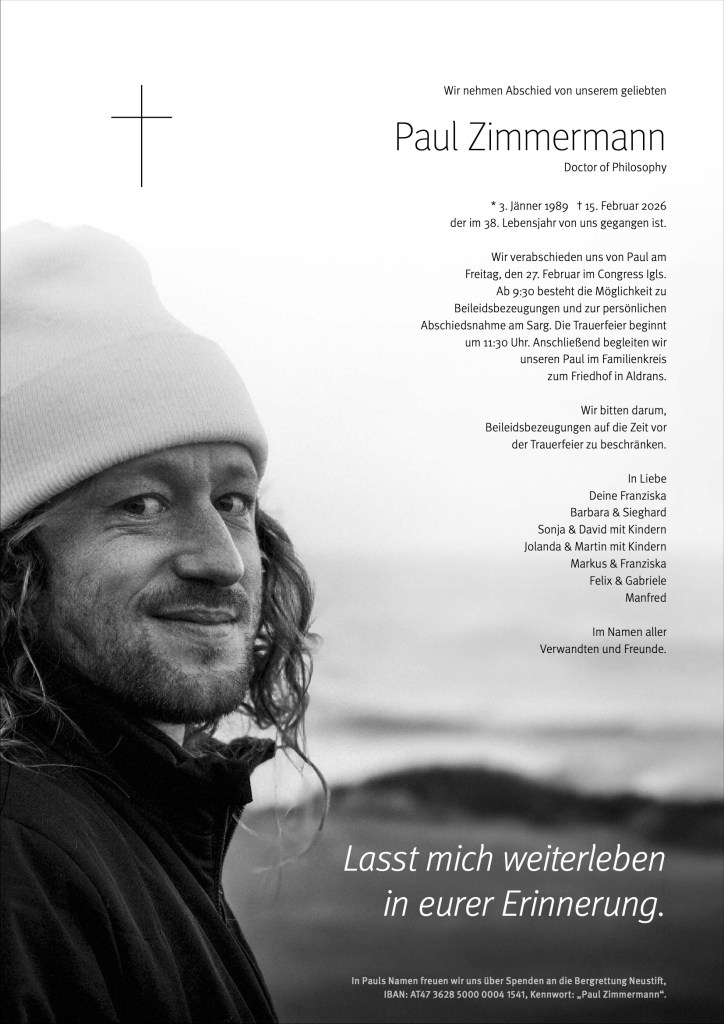
Parte Paul Zimmermann

New Article in Information & Organization: »Digital platforms and democratic publics: How social media platforms selectively appropriate and strategically subvert institutional logics«

Cover of the Journal "Information & Organization"

One reason why it is so hard to reign into Big Tech social media platforms is their own contradictions. In a brand new article by Elke Schüßler, Sara Maric and myself, we try to unpack how Big Tech both expand and subvert democratic publics by looking at the case of YouTube – and explore the potentials and challenges of Fediverse alternatives based on decentralized architectures and distributed governance.

The issue is that both is true at the same time: YouTube has expanded our democratic public by lowering barriers for content creation and distribution; and it also has subverted our democratic public by amplifying extremist, emotionalising or propagandistic content.

To give another example, it is YouTube’s monopolistic market dominance is that makes it so strong and valuable as a market place for creators and users alike; at the same time, the proprietary governance by profit-driven algorithms leads to discriminatory practices such as shadow bans without accountability, frustrating both creators and users.

Continue reading “New Article in Information & Organization: »Digital platforms and democratic publics: How social media platforms selectively appropriate and strategically subvert institutional logics«”

New Article in Health Policy: »Experiences and social constructions of loneliness in later life: Collaborative focus group discussions in Germany«

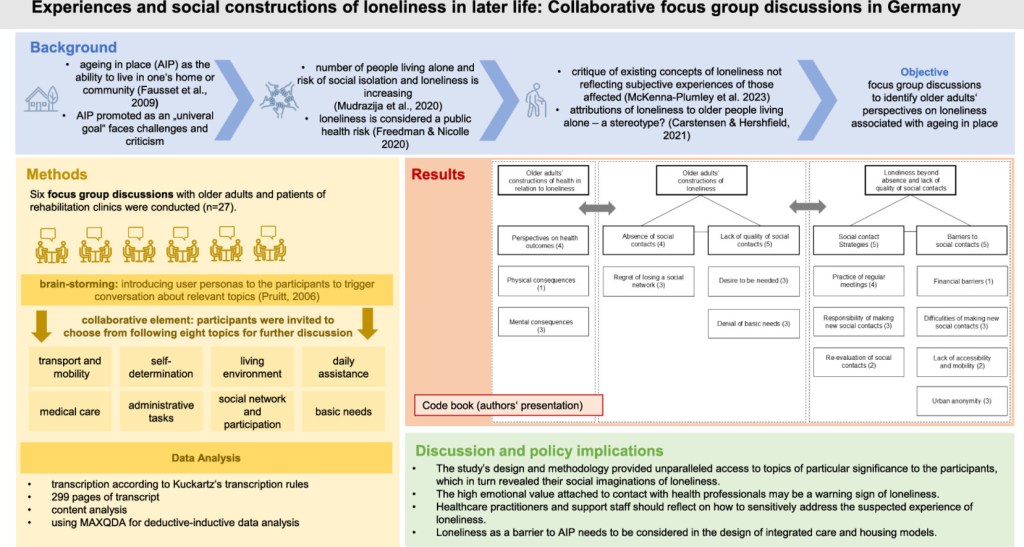
Graphical Abstract of the article "Experiences and social constructions of loneliness in later life: Collaborative focus group discussions in Germany"
Graphical abstract of the article

While Aging in Place – the possibility to grow old in one’s own home – is a wide-spread ideal for many people, it comes with an increased risk of loneliness in later life. In a study spearheaded by my PhD student Andrea Kastl and co-authored together with Ulrike Fettke, we empirically explored the perspectives and practices of dealing with loneliness as voiced by older people who want to age in place. The study entitled “Experiences and social constructions of loneliness in later life: Collaborative focus group discussions in Germany” has now been published in the journal Health Policy. Our main conclusions based upon collaborative focus group discussions:

Assessing loneliness requires taking individual perspectives into account, as mere quantification of social contacts is insufficient for evaluation or intervention design. To help cope with loneliness, health professionals are an important social interface and can become a substitute for close relationships. This should be reflected in professional roles and in developing complementary technologies and policies.

The article is available open access over at Health Policy.