EGOS 2024 Call for Short Papers: »Reorganizing Knowledge Practices in the Digital Era: Driven by Data, Out in the Open?«

The 40th EGOS Colloquium will take place from July 4-6, 2024, in Milan, Italy, and I am very happy to co-convene a sub-theme with Anne K. Krüger (Berlin-Brandenburg Academy of Sciences and Humanities) and Neil Pollock (University of Edinburgh Business School, UK). Please find the Call for Short Papers (about 3.000 words) of sub-theme 61 on “Reorganizing Knowledge Practices in the Digital Era: Driven by Data, Out in the Open?” below, submission deadline is January 09, 2024. Please also have a look at the submission guidelines.

Organizations produce, offer and structure knowledge that not only provides us with new insights but also triggers new developments. They display information that is supposed to support decision-making of people, enterprises, or politicians ranging from statistic reports, e.g. on demographic developments (Desrosières 1998), evaluation, e.g. of the credit-worthiness of individuals and nation states (Besedovsky 2018; Kiviat 2019) or of the performance of hospitals (Reilley and Scheytt 2019) and prisons (Mennicken 2013) to rankings of start-ups (Pollock and D’Adderio 2012), universities (Espeland and Sauder 2016; Wilbers and Brankovic 2021) or entire cities (Kornberger and Carter 2010). Much of our “knowledge about the world” is provided by organizations and highly organized processes. Particularly in times of perceived uncertainty and existential environmental threats (Bacevic 2021) such knowledge is having a crucial effect on our understanding of social problems and possible solutions.

Yet, in light of mounting demands for open access, open source, open data and open science (Bacevic and Muellerleile 2018; Dobusch et al., 2023) as well as increasing accumulation of mass data and their automated analysis (Crawford 2021), digitization presents a crucial crossroad for organizational knowledge production. These developments reorganize the ways how and which kind of knowledge is produced and offered. They not only amplify the possibilities of knowledge production in organizations and of access to knowledge through organizations but also allow for entirely new and very diverse forms of organizing knowledge creation and distribution, ranging from algorithm- and AI-based to volunteer- and crowd-driven. They furthermore influence what counts as knowledge, who has the authority to provide knowledge and how this knowledge informs our decisions and perception of what counts, e.g. as a trustworthy seller (Kornberger et al. 2017), as excellent science (Krüger and Petersohn 2022) or simply as good music (Alaimo and Kallinikos 2020).

Continue reading “EGOS 2024 Call for Short Papers: »Reorganizing Knowledge Practices in the Digital Era: Driven by Data, Out in the Open?«”
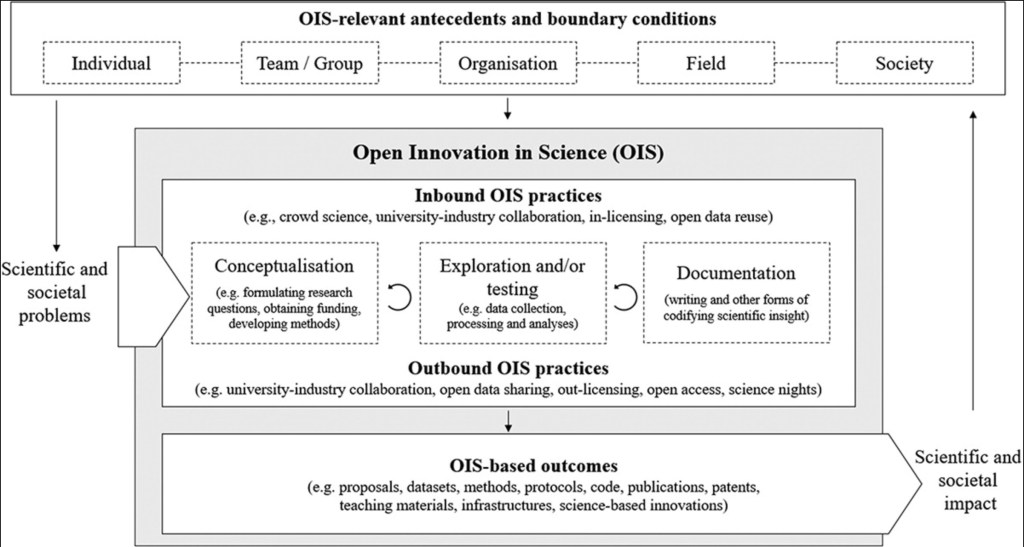
New Article in Industry & Innovation: “The Open Innovation in Science research field”

The article “The Open Innovation in Science research field: a collaborative conceptualisation approach”, published in Industry & Innovation, is the result of a collaborative authoring process. A group of 47 contributors (including myself) tried to bring together the concepts of Open Science and Open Innovation:

Openness and collaboration in scientific research are attracting increasing attention from scholars and practitioners alike. However, a common understanding of these phenomena is hindered by disciplinary boundaries and disconnected research streams. We link dispersed knowledge on Open Innovation, Open Science, and related concepts such as Responsible Research and Innovation by proposing a unifying Open Innovation in Science (OIS) Research Framework. This framework captures the antecedents, contingencies, and consequences of open and collaborative practices along the entire process of generating and disseminating scientific insights and translating them into innovation. Moreover, it elucidates individual-, team-, organisation-, field-, and society‐level factors shaping OIS practices. To conceptualise the framework, we employed a collaborative approach involving 47 scholars from multiple disciplines, highlighting both tensions and commonalities between existing approaches. The OIS Research Framework thus serves as a basis for future research, informs policy discussions, and provides guidance to scientists and practitioners.

In line with its topic, the article is available open access.

Ö1 Dimensionen »Von Elsevier zu Open Access«

In der jüngsten Folge der Reihe Dimensionen widmet sich Ö1-Journalistin Tanja Malle dem Thema (Hürden am Weg zu) Open Access in der Forschung. Aus der Beschreibung:

2017 machte Elsevier bei einem Umsatz von rund 2,8 Milliarden Euro eine Milliarde Gewinn. Weil Wissenschafter/innen und Forschende auf die Publikation in den renommierten Journalen angewiesen sind, bekommt Elsevier deren wissenschaftliche Papers de facto gratis. Da diese Forschung größtenteils vom Staat finanziert wird, macht Elsevier öffentlich finanziertes Wissen zu Geld. Gegen diese Politik regt sich nun zunehmend Widerstand. In Deutschland haben sich mehr als 200 Hochschulen, Forschungsinstitute und Bibliotheken zusammengeschlossen und bauen Druck auf, indem sie Elsevier-Abonnements auslaufen lassen. Sie fordern Open-Access-Lösungen

Ich durfte zu der Sendung auch einige O-Töne beisteuern und mich dabei unter anderem als bekennender Sci-Hub-Nutzer ohne diesbezüglich schlechtes Gewissen outen. Eine Woche lang ist die Sendung noch frei zum Nachhören online. (Leider sind ja auch die Radiosendungen von öffentlich-rechtlichen Rundfunkanbietern wie Ö1 nicht auch dauerhaft Open Access zugänglich 😉 ).

Fake Science and Predatory Journals: Antidote Open Peer Review?

Is Open Peer Review an Antidote against predatory publishers? (Credit: SarahRichterArt, CC0)

Digitalization reduces technological and financial barriers to scientific publishing. Science can thus become faster, more inclusive and more plural. At the same time, the growing acceptance of specific forms of Open Access has also led to the rise of author-pays business models based on Article Processing Charges (APCs). The increasing publication pressure in the scientific system in combination with APCs provides incentives for creating “predatory” journals that only supposedly or very superficially conduct peer review in order to maximize their profits from such APCs. These manuscripts are at best inadequate and at worst deliberately tendentious and misleading.

Recently, an investigative report by the German newspaper Sueddeutsche Zeitung and public broadcasters WDR and NDR has revealed that even researchers from reputable academic institutions publish in or represent publishers of dubious quality. In their attempt to reveal “Fake Science” (using the English term in their German reportings), journalists easily accomplished the publication of a non-sensical article in an allegedly peer reviewed journal charging APCs. What they also show is how these unscientific practices not just harm the reputation of legitimate open access journals but are also a potential source – and allegedly scientific proof – for fake news more generally.

This blogpost discusses how reputable (Open Access) journals can defend their credibility against somewhat or even completely dubious Open Access journals. In our opinion, the most sustainable response, which however would only be possible in the mid to long-term, would be to abandon author-pays business models altogether and switch to publication infrastructures financed by universities and institutions (for an example of such an approach, check out the Open Library of Humanities). In the short-term, however, certain open-peer review practices might also be helpful to address the problem of predatory open access journals.

>> Read the remainder of the full post at governance across borders

Neuer Beitrag: »Von Fake Journals zu Fake News: Ausweg Open Peer Review?«

Gemeinsam mit Maximilian Heimstädt (Universität Witten-Herdecke) habe ich für die aktuelle Ausgabe von “Synergie – Fachmagazin für Digitalisierung in der Lehre” einen Beitrag zu den Risiken von Predatory Publishing für die Rezeption von (vermeintlich) wissenschaftlichen Erkenntnissen sowie den Potentialen von Open Peer Review in diesem Zusammenhang beigesteuert (PDF des Beitrags). Aus der Einleitung:

Die wachsende Akzeptanz spezifischer Formen von Open Access hat zum Aufstieg von Author-Pays-Geschäftsmodellen geführt, die auf „Article Processing Charges“ (APC) beruhen. Der steigende Publikationsdruck im Wissenschaftssystem in Kombination mit APC setzt Anreize für die Gründung von Zeitschriften, die nur vermeintlich oder sehr oberflächlich ein Begutachtungsverfahren (Peer Review) durchführen, um gebührenpflichtig und möglichst profitmaximierend Manuskripte zu veröffentlichen. Diese Manuskripte sind im besten Fall mangelhaft und im schlechtesten Fall absichtlich tendenziös und irreführend.

Die gesamte Ausgabe von Synergie ist open access als PDF oder ePub verfügbar.