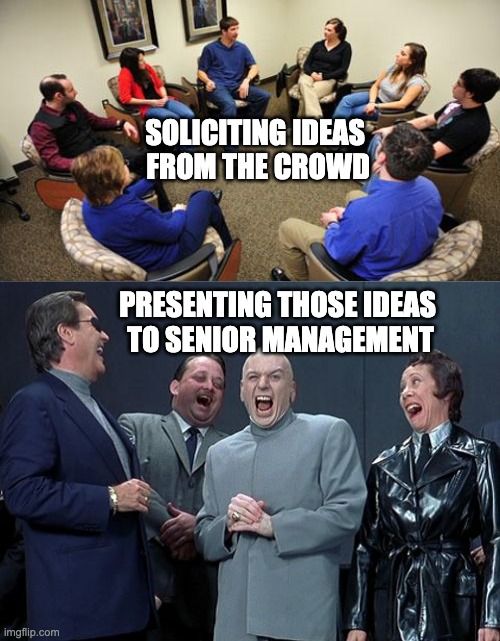
Led by Katharina Zangerle, who collected data at a large pharmaceutical corporation in Austria and Switzerland, we are very happy to announce the first joint article by three members of the organization unit at the Department of Organization and Learning, as Katharina had teamed up with Richard Weiskopf and myself for crafting the article.
The study entitled “Barracudas, Piranhas and crowds: making ideas valuable in pharmaceutical innovation through opening and closing practices of valuation” is now available open access at Innovation: Organization & Management. The abstract reads as follows:
Attributing value to ideas is central in the journey from generating and elaborating ideas, to realising ‘creative’ products and processes. In this study, we explore the ways in which ideas are attributed value through practices of valuation in the innovation process. We examine valuation practices and intentionally and deliberately designed digital and analog spaces in pharmaceutical innovation across various stages of the ‘idea journey’. The findings shed light on the valuation of objects and emerging ideas as well as unveiling how pharmaceutical firms adapt valuation practices in times of crisis, when the imperative to generate novel solutions intensifies. The empirical case illustrates the interplay between ‘opening’ valuation practices, such as crowd votings facilitated by a digital ideation software, and ‘closing’ mechanisms, such as idea rankings within exclusive evaluation boards, or idea clustering through the digital device, as well as how these practices enable a working consensus on defining what qualifies as new and valuable within the organisation. While closing valuation with its quantifying practices might allow for efficient decision-making in organising novelty, it may turn out to be problematic when it comes to achieving organisational legitimacy in innovation processes. Balancing opening and closing mechanisms seems crucial in innovation processes, particularly in times of uncertainty. Taking a closer look at the spatial and temporal conditions and dynamics of valuation, as well as the role of digital technology in the production of value advances the understanding of how value is produced.
The research has been conducted in the realm of joint DFG and FWF research project on “Organized Creativity” and regulatory uncertainty in music and pharma.

 ConJunction