Neuer Artikel: »Kompetitiv und kooperativ: Zur Neuordnung des Verhältnisses von privaten und öffentlich-rechtlichen Medien im Digitalzeitalter«

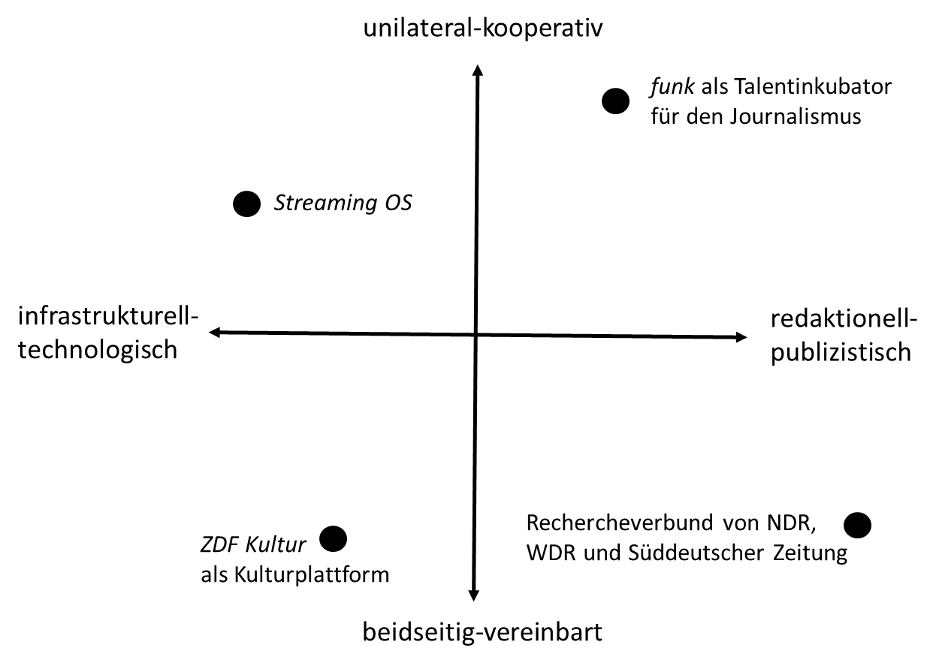
Abbildung: Formen kooperativer Beziehungen zwischen öffentlich-rechtlichen und privaten Medien mit Ankerbeispielen
Formen kooperativer Beziehungen zwischen öffentlich-rechtlichen und privaten Medien mit Ankerbeispielen

Das Verhältnis zwischen privaten und öffentlich-rechtlichen Medien wird in Deutschland traditionell als ein wettbewerbsorientiertes Nebeneinander und gegenseitiges Ausbalancieren wahrgenommen und geregelt. Der digitale Wandel und die zunehmende Dominanz von Plattformen stellen diese Sichtweise jedoch zunehmend in Frage.

Als Antwort darauf plädieren Christopher Buschow (Hamburg Media School) und ich in einem im Wirtschaftsdienst erschienen Beitrag für einen Coopetition-Ansatz, bei dem Wettbewerb und Zusammenarbeit nebeneinander bestehen, um demokratische Öffentlichkeiten zu stärken.

Continue reading “Neuer Artikel: »Kompetitiv und kooperativ: Zur Neuordnung des Verhältnisses von privaten und öffentlich-rechtlichen Medien im Digitalzeitalter«”

New Handbook Chapter: »Open Strategy as a New Form of Strategizing«

Together with Julia Hautz and Thomas Ortner (both situated at the neighboring department of Strategic Management and Leadership), I had the honor to contribute to the most recent iteration of the Cambridge Handbook of Strategy as Practice with a chapter on “Open Strategy as a New Form of Strategizing”:

[W]e can observe an increasing trend towards more inclusive and transparent strategizing. From a practice perspective, this trend can be described as a shift in the practices of strategy-making. [We] describe the different practices of inclusiveness and transparency and show how they relate to each other. [We] then identify and review distinctive themes of strategy as practice research on Open Strategy. This includes the role of technologies and materiality in enabling openness, the discursive practices and processes underpinning openness, the temporal dynamics of open processes, the difference between controlled and uncontrolled forms of openness and the dialectic relationship between openness and closure.

Check out the article here – and please contact me to receive a personal copy in case your institution does not provide access to the handbook.