
Together with my sister Laura and Katharina Kreissl, we were given the opportunity to contribute a chapter to “The Handbook of Organizing Economic, Ecological and Societal Transformation”, edited by Elke Weik, Chris Land and Ronald Hartz. In our contribution entitled “Searching for Transformative Potential: Comparing Conceptualizations of Open, Inclusive and Alternative Organizations”, we analyze scholarly approaches that explicitly imagine organizations as capable of ‘doing good’ under the labels of “open”, “inclusive” or “alternative. Check out the abstract below:
In this chapter, we analyze scholarly approaches that explicitly imagine organizations as capable of ‘doing good’ and investigate which answers they give to the urgent need of stimulating socio-ecological transformations. We compare three streams of literature on open, inclusive and alternative organizations. We define the transformative potential of these approaches as related to ideas of (1) de-/postgrowth and other alternatives to profit-oriented organizing; and of (2) making room for historically disadvantaged and particularly marginalized groups at the organizational power table. In our conclusion, we argue that the scale of transformative change needed asks scholars to transgress commonly separated camps of scholarship and, thus, to eclectically engage with all three organizational approaches to organize for socio-ecological transformations. At the same time, this requires challenging institutionalized underpinnings of how we organize scholarship as such.
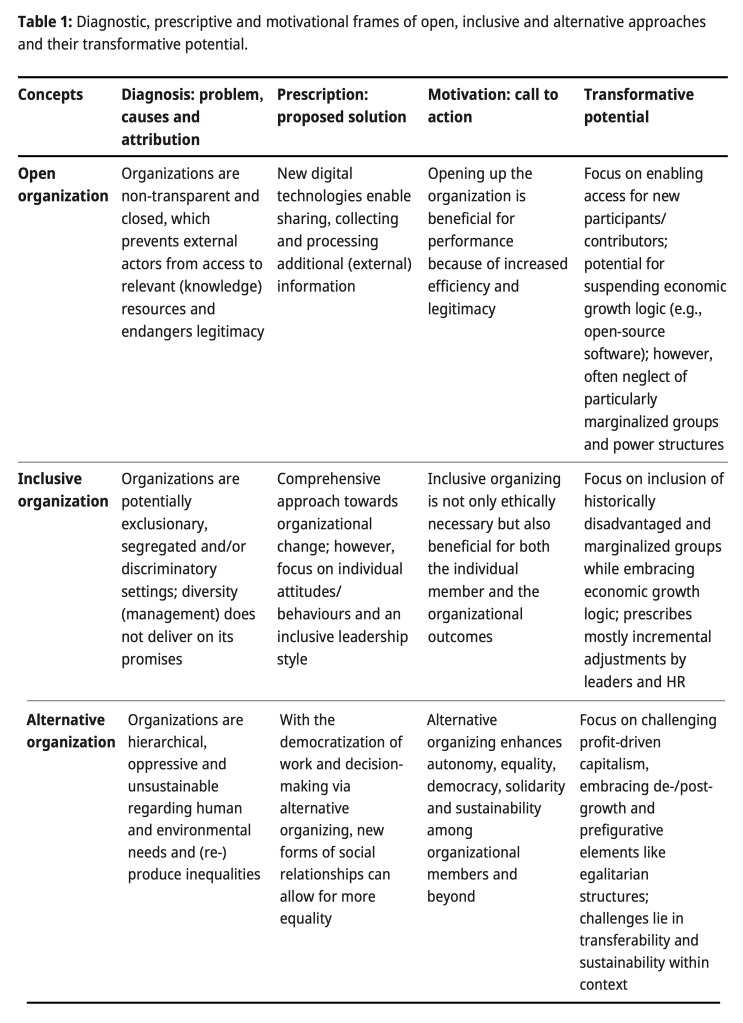
A very brief and condensed overview about our comparative analysis is provided in Table 1 below:
Please do not hesitate to contact us in case you are interested in the chapter and you or your institution does not provide access to it.
 ConJunction