Digital platforms, like Instagram, offer various ways for self-expression, support, and community building, but their content moderation practices reveal deep-rooted biases that affect who gets to participate platform organizing. In our recent paper “‘Your Very Existence Goes Against Our Community Guidelines’: Interrogating norms of contributorship through poetic speech acts on Instagram” in Organization Studies, we – Monica Nadegger, Milena Leybold and Sean Kenney – explore how these platforms enforce norms through content moderation, shaping what contributions are deemed appropriate. Find out more in this blog post and in the full paper.
Key Concept: Norms of Contributorship
We discuss how platform moderation, particularly around nudity, reflects societal norms that privilege certain types of content, contributions, and also identities while marginalizing others. the authorization of contributions is governed by “norms of contributorship”—unspoken rules on what contributions are appropriate or allowed and thus can become organizational. These norms often reflect broader biases related to gender, race, and sexuality, reinforcing existing power structures.
Queer Theory and Poetic Speech Acts
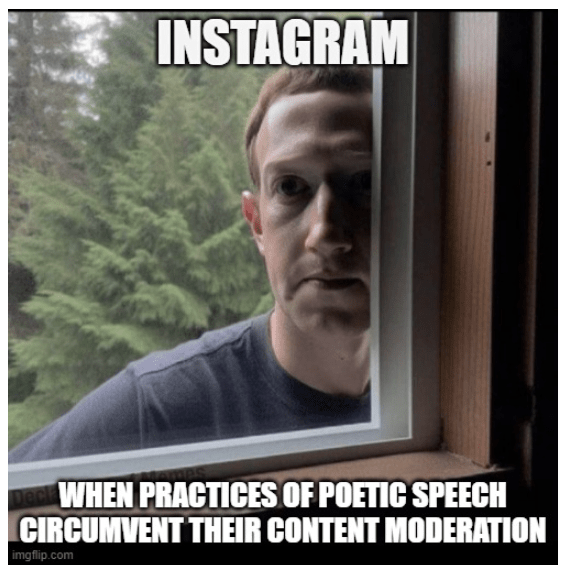
Using queer theory, we examine how users resist these norms through creative forms of expression, or “poetic speech acts.” These acts challenge the platform’s moderation policies by using playful alterations, juxtapositions, and satire to subvert rules and expose biases. For example, users may alter images or text to comply with guidelines while still critiquing them, or they may use humor to highlight the contradictions in moderation decisions.
These poetic speech acts reveal the power dynamics at play in platform organizing and highlight how certain voices are excluded. By queering norms of contributorship, users repoliticize these digital spaces and open up new possibilities for platform organizing.
You can find the full article here (open access).
 ConJunction